FarSounder sonar for RNLN vessels
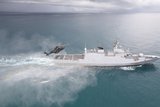
FarSounder’s 3D sonar systems have been selected for the Royal Netherlands Navy’s (RNLN’s) hydrographic survey vessels, the company announced on 30 July.
The company’s Forward-Looking Sonar (FLS) will provide the crew of HNLMS Snellius and HNLMS Luymes with real-time data that updates at every ping on their bridge regarding what lies ahead under the water as the ships navigate.
Snellius and Luymes carry out military and public safety operations, along with hydrographic survey duties in both the North Sea and the Netherlands Antilles. These duties include rapid environmental assessments, in addition to bathymetry and route surveys. The FarSounder FLS’ local history mapping capability allows for true real-time mapping of the seafloor. This map updates every two seconds and can be saved for future use.
The equipment will be installed as part of the vessels’ mid-life upkeep programme, being carried out by Damen Shipyards Den Helder.






More from Naval Warfare
-
![Italy sets course for a decade of sustained naval investment]()
Italy sets course for a decade of sustained naval investment
The country's long-term growth plan to overhaul its fleets well into the 2030s could open the door to an array of opportunities for suppliers.
-
![FNSS looks to put uncrewed vehicles at the front of amphibious assaults]()
FNSS looks to put uncrewed vehicles at the front of amphibious assaults
The new platform is designed to put reconnaissance, obstacle clearance and fire support ahead of the crewed force in a contested landing.
-
![Ireland’s strategic cable role grows as naval capacity falls behind]()
Ireland’s strategic cable role grows as naval capacity falls behind
Around 75% of the northern hemisphere’s undersea cables transit Irish waters, but personnel shortfalls and a stalled multirole vessel programme leave patrol capacity in question.
-
![US turns to allies to tackle navy shipbuilding backlog]()
US turns to allies to tackle navy shipbuilding backlog
A White House memorandum acknowledges US Navy shipbuilding backlogs and a weakened industrial base, opening a formal path for South Korean and Japanese yards to help rebuild capacity.
-
![US Navy’s $275 billion BBGN plan hinges on shipyard transformation]()
US Navy’s $275 billion BBGN plan hinges on shipyard transformation
The US Navy’s planned nuclear-powered warship carries a US$275 billion price tag, but the greater story lies in the industrial overhaul needed to build it, from AI-enabled design to digital twins and modular construction.