Emirati and Israeli companies pledge joint USV development
Pictured (left to right): Boaz Levy, IAI president and CEO; Yehuda Lahav, EVP Marketing IAI; David Massey, CEO ADSB; and Faisal Al Bannai, EDGE CEO and MD. (Photo: IAI)
UAE-made 17m USV family to include autonomous technology from Israel.


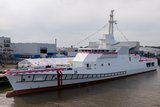
EDGE on 18 November announced an agreement with Israel Aerospace Industries (IAI) to conduct joint development of ‘a first-in-class series of 17m unmanned surface vessels (USVs) for the entire range of military and commercial applications’, the defence conglomerate noted in a statement.
EDGE added that its Abu Dhabi Ship Building subsidiary will design the platform, integrate the control systems and payload and develop the CONOPS for this new family of USVs, while IAI will develop the autonomous control system and integrate various mission payloads according to specific mission requirements.
IAI may leverage its experience in developing the optionally crewed 11.9m-long Katana USV, which it unveiled in early 2014. In the aftermath of the Abraham Accords which normalised relations between Israel and the UAE, Shephard reported that USVs could prove a fruitful area of defence industrial collaboration between the two countries.
In the future UAE-made design, advanced sensors, sonars and imaging systems will be integrated into a unified C2 system with AI algorithms, so that the bespoke USV can operate either remotely, semi-autonomously or autonomously.
Military applications for the USV would include ISR, border and littoral zone patrol, maritime security, mine detection and sweeping, submarine detection and anti-submarine warfare, EDGE stated.
EDGE CEO Faisal Al Bannai emphasised the importance of collaborating with companies such as IAI ‘to strengthen our advanced technology portfolio’, while also opening ‘many doors for us in local and global markets, military and commercial alike’.


More from Naval Warfare
-
![Argentina’s submarine and frigate acquisitions resurface with $3.5bn funding plan]()
Argentina’s submarine and frigate acquisitions resurface with $3.5bn funding plan
Buenos Aires set out foreign loans worth $3.5 billion in its draft 2027 budget, opening a contest in which Naval Group and TKMS could lead the field.
-
![Industrial teams prepare roadmap for Indonesia aircraft carrier transformation]()
Industrial teams prepare roadmap for Indonesia aircraft carrier transformation
Fincantieri and PT PAL have agreed on a framework to modernise the former Giuseppe Garibaldi, with drones, communications and broader Italian–Indonesian industrial ties involved.
-
![Singapore expands maritime presence with future-ready Sentinel OPV]()
Singapore expands maritime presence with future-ready Sentinel OPV
Singapore is building space for uncrewed systems and future technologies into its new Sentinel-class OPVs, reflecting a wider move towards adaptable vessels capable of maintaining persistent maritime presence.