Eastern Shipbuilding Group awards Northrop Grumman integration contract for USCG OPCs
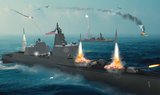
Artist’s rendition of USCGC ARGUS, the first vessel of the Heritage Class Fleet of Offshore Patrol Cutters. (Image: Eastern Shipbuilding Group)
Eastern Shipbuilding Group has awarded Northrop Grumman a contract as systems integrator for the US Coast Guard Offshore Patrol Cutter programme.


Northrop Grumman has been awarded a contract as systems integrator for C5ISR and control systems on the US Coast Guard (USCG) Offshore Patrol Cutter (OPC).
The contract was awarded by Eastern Shipbuilding Group, the prime contractor for the OPC programme.
In the newly expanded role, Northrop Grumman is responsible for integrating all cyber-hardened C5isr systems, including command and control, communications, navigation and shipboard computer networking systems.
Northrop Grumman will also be responsible for the integrated bridge, data distribution, machinery control, propulsion control systems, cyber/information assurance, testing and integration work.
Eastern Shipbuilding Group is currently developing the Heritage-class OPCs for the US Coast Guard.
According to Shephard Defence Insight, the Heritage-class OPC will bridge the capability gap between the National Security Cutter, which patrols the open ocean, and the Fast Response Cutter, which operates closer to shore.
The Coast Guard aims to procure a total of 25 OPCs with an estimated total acquisition cost of $10.523 billion.
The OPCs will feature helicopter capability, with the ability to carry MH-60R or MH-65 helicopters and three operational over-the-horizon small boats.
Related Equipment in Defence Insight

More from Naval Warfare
-
![US turns to allies to tackle navy shipbuilding backlog]()
US turns to allies to tackle navy shipbuilding backlog
A White House memorandum acknowledges US Navy shipbuilding backlogs and a weakened industrial base, opening a formal path for South Korean and Japanese yards to help rebuild capacity.
-
![US Navy’s $275 billion BBGN plan hinges on shipyard transformation]()
US Navy’s $275 billion BBGN plan hinges on shipyard transformation
The US Navy’s planned nuclear-powered warship carries a US$275 billion price tag, but the greater story lies in the industrial overhaul needed to build it, from AI-enabled design to digital twins and modular construction.
-
![Asia-Pacific emerges as the largest export market for US-made USVs]()
Asia-Pacific emerges as the largest export market for US-made USVs
Asian customers have placed one of the largest known international purchases of US-built uncrewed surface vessels, highlighting accelerating regional demand for autonomous maritime capabilities and distributed naval operations.