Details of GRSE’s small anti-submarine corvette emerge


The Indian Navy’s (IN) Anti-Submarine Warfare Shallow Water Craft (ASWSWC) project of 16 hulls will be split evenly between two shipbuilders, Cochin Shipyard Limited (CSL) and Garden Reach Shipbuilders & Engineers (GRSE).
Each shipyard will build its own variant of a 700t waterjet-powered ASW corvette working to common IN-issued specifications. The ASWSWC is intended for coastal ASW missions, minelaying and maritime security operations within 200nm of the coastline.
While CSL revealed broad specifications of its variant earlier this year, details of GRSE’s ship emerged recently as it seeks vendors to perform basic design work and specialised engineering studies on the proposed design. Given their association with GRSE’s existing projects, Kockums/Saab, Naval Group and Fincantieri are likely contenders.
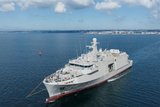
GRSE’s design has an overall length of 77m, beam of 10.5m and displaces about 750t. It has elements of the X-shaped hull form used in the Kamorta-class corvette.
CSL’s design is slightly shorter at 74m, and it has a beam of 10.5m and somewhat different topside arrangement with slab sides. Otherwise, performance figures and overall propulsion system configuration is similar to GRSE’s. Both have three diesel-driven waterjet units, a top speed of 25kt and range of 1,800nm at 14kt. They will be the biggest waterjet-powered vessels in the IN.
Combat systems include one ASW rocket launcher, two sets of torpedo tubes, small-calibre cannon, mine-laying rails, hull-mounted sonar and towed low-frequency variable-depth sonar. Given its ASW focus, signature management (particularly acoustic silencing) is expected to be a key feature.
An industry source familiar with the project noted that, while the IN would have preferred a common design, GRSE with its large in-house design team is ‘reluctant’ to do so and is pushing ahead with its own variant.
Earlier expectations from GRSE’s management for a contract signing by October did not materialise, but pre-production work is progressing.
Contractually, each shipbuilder is required to build and deliver eight hulls within 84 months. Delivery of the first hull is to be ‘within 42 months’ of contract signing, and subsequent hulls at six-monthly intervals.


More from Naval Warfare
-
![A400M trial demonstrates airborne deployment of uncrewed surface vessel]()
A400M trial demonstrates airborne deployment of uncrewed surface vessel
Kraken Technology Group’s A400M airdrop of a K3 Scout uncrewed surface vessel points to a new way for navies to insert USVs into contested waters, bypassing ports and motherships.
-
![Babcock onshores 85% of Canada’s submarine supply chain as it eyes future CPSP programme]()
Babcock onshores 85% of Canada’s submarine supply chain as it eyes future CPSP programme
By moving most of the Royal Canadian Navy’s submarine supply chain into Canada, Babcock Canada is driving to strengthen sovereign sustainment capabilities while preparing to compete to maintain the future Canadian Patrol Submarine Project.
-
![From the seas to the web: the changing shape of UK defence in Southeast Asia]()
From the seas to the web: the changing shape of UK defence in Southeast Asia
As his final engagement before leaving his post as the head of the British defence staff for Southeast Asia and defence adviser to Singapore, Brigadier Eddie Maskell-Pedersen spoke with Shephard about maritime security, cyber cooperation and long-term partnerships.
-
![Baltic naval priorities shift towards mine warfare and versatile platforms]()
Baltic naval priorities shift towards mine warfare and versatile platforms
Baltic states are investing in mine warfare, uncrewed systems and multirole platforms as major warship purchases remain scarce, industry sources indicate.