DCNS tests maritime combat system demonstrator


DCNS has tested a new ship-borne anti-terrorism and anti-piracy combat system demonstrator in Toulon harbour, France.
It’s designed to help accelerate decision making and prevent collateral damage in close-quarter defence situations.
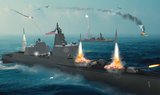
A piracy attack was simulated and the DCNS combat system demonstrator showed how quickly it could be used to deploy asymmetric defences.
Ultra-high-definition, 360-degree cameras are dotted around the vessel to gather video footage of the surrounding area and this is then superimposed on top of augmented reality images to allow operators to pick out which vessels aren’t behaving as they should.
When an operator sees suspicious activity they can use a powerful zoom lens to confirm whether or not the threat is real and a response can be implemented, ranging from simply issuing a sound or light warning signal to a warning shot or final protective fire.
There’s even a camera mounted on the weapon to minimise the chance of collateral damage.
The new combat system is compatible with a large number of ships and can operate autonomously or can be integrated within a Combat Management System (CMS) to benefit from other information provided by the vessel’s other sensors or from sensors on board a UAV, which promises an exciting opportunity for surveillance in the future.

You may also like


More from Naval Warfare
-
![US turns to allies to tackle navy shipbuilding backlog]()
US turns to allies to tackle navy shipbuilding backlog
A White House memorandum acknowledges US Navy shipbuilding backlogs and a weakened industrial base, opening a formal path for South Korean and Japanese yards to help rebuild capacity.
-
![US Navy’s $275 billion BBGN plan hinges on shipyard transformation]()
US Navy’s $275 billion BBGN plan hinges on shipyard transformation
The US Navy’s planned nuclear-powered warship carries a US$275 billion price tag, but the greater story lies in the industrial overhaul needed to build it, from AI-enabled design to digital twins and modular construction.
-
![RTX confirms US Marine Corps and US Navy acquire Hadalus UUV]()
RTX confirms US Marine Corps and US Navy acquire Hadalus UUV
RTX told Shephard that the Hadalus UUV has been procured by the US Marine Corps and the Office of Naval Research for operational experimentation as the company prepares additional demonstrations with the US Navy, NATO and AUKUS partners.
-
![Europe’s naval contractors benefit from growing refit and upgrade demand]()
Europe’s naval contractors benefit from growing refit and upgrade demand
Rheinmetall’s order to modernise the German Navy frigate Bayern points to a wider European shift towards extending warship service life as new-build programmes face delay.