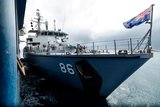
Damen SAR vessel completes capsize test


Damen has completed full scale roll-over testing of its Search and Rescue 1906 vessel with running engines, in Antalya, Turkey, the company announced on 15 November.
The testing was carried out in cooperation with the Turkish Coast Guard, the International Organization for Migration and engine manufacturer MTU.
The SAR 1906 vessel’s hull has been adapted from Damen’s Axe Bow technology which provides seakeeping capabilities to operate in all weathers and sea states, including the ability to right itself following capsize.
According to the company, in the event of a vessel capsize in extreme weather conditions, the capsize switch detects the roll-over and sends out signals to, for example, the engine software which will go into ‘roll-over mode’. During this period, the water jets are automatically clutched out and the engine returns to idle mode to protect the engine. This continues until the software detects the vessel has righted itself and the crew can directly regain control.
Meredith Dijkstra, product portfolio manager high speed craft, Damen, said: ‘We have been working closely with MTU to develop and improve engine software that is able to handle a capsize situation. This has been backed up by engine roll-over tests at their facilities and our own proven investigations into the roll-over capacity of the SAR 1906.’

You may also like
More from Naval Warfare
-
![Suppliers await next step in Australia’s mine warfare transition]()
Suppliers await next step in Australia’s mine warfare transition
Australia’s mine countermeasure capability remains in flux as the Huon-class nears retirement, but accelerated investment in autonomous systems is opening a path for industry.
-
![Can the US Navy ask Indo-Pacific allies to do more while training with them less?]()
Can the US Navy ask Indo-Pacific allies to do more while training with them less?
As the Iran War draws US ships and marine corps units away from the Indo-Pacific, curtailed exercises and a temporary carrier gap are exposing tensions between Washington’s demand for more self-reliant allies and the joint training needed to realise that ambition.
-
![How could Rheinmetall’s GMF 140 fit with ongoing programmes in North America?]()
How could Rheinmetall’s GMF 140 fit with ongoing programmes in North America?
With Canada committed to its River-class replacement and the USN pursuing a lower-cost frigate, Rheinmetall will need to demonstrate where the GMF 140 can fill a capability gap in the North American fleet.
-
![Australian industry programme builds pipeline for Virginia-class sustainment]()
Australian industry programme builds pipeline for Virginia-class sustainment
Australian businesses can now bid to support Virginia-class submarine sustainment in Western Australia, as momentum around the Henderson Defence Precinct also builds.
-
![South Korea, Japan and Turkey vie for US shipbuilding access in future frigate contest]()
South Korea, Japan and Turkey vie for US shipbuilding access in future frigate contest
Washington’s search for a foreign-built frigate could hand South Korea, Japan and Turkey a larger prize than a double-hull order: a foothold inside the US shipbuilding industrial base.