Damen details new OPV design


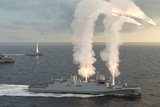
Damen has released details of its newest Offshore Patrol Vessel (OPV) at the OPVs & Corvettes Asia Pacific conference in Singapore on 20 April.
The second generation OPV has been configured for various missions. It features Damen’s Sea Axe hull shape, giving it advanced seakeeping capabilities, including exceptional low heave accelerations for stable passage even in rough seas.
With the hull designed to reduce water resistance, the new OPV is also highly fuel efficient and capable of speeds up to 25/26 knots.
The vessel has been designed for maximum versatility, with three multi-mission locations: the bridge, hangar and bay. The Multi-Mission Bay (MM Bay) can be equipped with dedicated mission modules (such as mission containers) for missions such as counter piracy, counter-drug operations, anti-mining warfare, and search-and-rescue (SAR). The MM Bay is also equipped with a nine metre rigid-hulled inflatable boat, which can be launched over a dedicated slipway through the rear of the vessel while the OPV is sailing. In the Damen-built Holland Class Ocean Patrol vessels for the Royal Netherlands Navy this system has already proven to be safe in operations up to SS 5 conditions.
The OPV’s command-and-control (C2) centre - the Multi-Mission Bridge (MM Bridge) - is located directly behind the bridge. Both spaces can be separated by means of a blinded sliding wall. During a mission when lowering the sliding wall, situation awareness in the C2 centre is improved.
Piet van Rooij, design and proposal manager, Damen, said: ‘Today OPVs don’t engage in combat situations as often as frigates do, however, fast and effective coordination during a ‘chase’ is essential for an OPV.’
The Multi-Mission Hangar (MM Hangar) is capable of storing an 11-tonne NH-90 helicopter and a UAV such as the Boeing ScanEagle. The MM Hangar has been designed so that the OPV crew can deploy either the helicopter or the UAV without having to move either one. Furthermore, there is space for a spare parts store and workshop for both the helicopter and UAV.
The OPV is available as a standard in four series: 75m – 1400 tonnes; 85m – 1800 tonnes; 95m – 2400 tonnes; and 103m – 2600 tonnes.
Related Equipment in Defence Insight

You may also like

More from Naval Warfare
-
![How France’s SNLE 3G programme is reshaping the naval nuclear industrial base]()
How France’s SNLE 3G programme is reshaping the naval nuclear industrial base
Extending far beyond a four-submarine replacement programme, France’s ballistic missile submarine effort is a decades-long industrial effort designed to preserve the country’s ability to build and sustain nuclear-powered strategic platforms.
-
![China’s mineral processing dominance exposes naval supply chain vulnerabilities]()
China’s mineral processing dominance exposes naval supply chain vulnerabilities
Competition for critical minerals, and China’s dominance of their processing, is emerging as a decisive factor in future naval procurement programmes.
-
![Suppliers await next step in Australia’s mine warfare transition]()
Suppliers await next step in Australia’s mine warfare transition
Australia’s mine countermeasure capability remains in flux as the Huon-class nears retirement, but accelerated investment in autonomous systems is opening a path for industry.
-
![Can the US Navy ask Indo-Pacific allies to do more while training with them less?]()
Can the US Navy ask Indo-Pacific allies to do more while training with them less?
As the Iran War draws US ships and marine corps units away from the Indo-Pacific, curtailed exercises and a temporary carrier gap are exposing tensions between Washington’s demand for more self-reliant allies and the joint training needed to realise that ambition.
-
![How could Rheinmetall’s GMF 140 fit with ongoing programmes in North America?]()
How could Rheinmetall’s GMF 140 fit with ongoing programmes in North America?
With Canada committed to its River-class replacement and the USN pursuing a lower-cost frigate, Rheinmetall will need to demonstrate where the GMF 140 can fill a capability gap in the North American fleet.