China carries out naval drills in Pacific as Taiwan tensions rise


China has carried out aircraft carrier drills in the Pacific, its navy said 21 April, ramping up tensions with Taiwan over its military exercises in the sensitive region.
Beijing’s sole aircraft carrier and two destroyers carried out ‘offensive and defensive drills to test their combat muscle’ on 20 April, China’s navy said on its official microblog site on Weibo.
The exercises took place in an area east of the Bashi Channel, which runs between Taiwan and the Philippines, it said.
China sees democratically-governed Taiwan as a renegade part of its territory to be brought back into the fold and has not ruled out reunification by force.
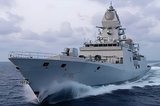
In Beijing’s latest military drills, photos showed J-15 fighters waiting to take off from the Liaoning aircraft carrier. The destroyers Jinan (pictured) and Changchun also participated in the exercise.
Taiwan has accused China of ‘sabre rattling’ after Chinese bombers and spy planes flew around Taiwan 19 April, and the Chinese navy conducted live-fire drills off the Taiwan Strait a day earlier.
‘China has deliberately manipulated [the exercise] to pressure and harass Taiwan in an attempt to spark tensions between the two sides and in the region,’ Chiu Chui-cheng of Taiwan’s Mainland Affairs Council told a regular briefing 19 April.
‘[We] will never bow down to any military threat and incentive.’
Beijing has stepped up military patrols around Taiwan and used diplomatic pressure to isolate it internationally since pro-independence President Tsai Ing-wen took office.
Chinese President Xi Jinping observed the navy’s largest-ever military display this month in the South China Sea, which involved 76 fighter jets and a flotilla of 48 warships and submarines.
Beijing has also been angered by Washington’s arms sales to Taipei, and China protested last month after President Donald Trump signed a bill allowing top-level US officials to travel to Taiwan.
Washington switched diplomatic recognition from Taiwan to China in 1979 but maintains trade relations with the island.


More from Naval Warfare
-
![Competitive P17B tender marks a shift in Indian Navy frigate procurement]()
Competitive P17B tender marks a shift in Indian Navy frigate procurement
The Indian Navy's P17B programme is expected to combine greater weapons capacity with a competitive domestic construction model, although key systems could remain dependent on international supply chains.
-
![How France’s SNLE 3G programme is reshaping the naval nuclear industrial base]()
How France’s SNLE 3G programme is reshaping the naval nuclear industrial base
Extending far beyond a four-submarine replacement programme, France’s ballistic missile submarine effort is a decades-long industrial initiative designed to preserve the country’s ability to build and sustain nuclear-powered strategic platforms.
-
![Quantum Systems enters maritime domain with Baltic-focused USV and UUV]()
Quantum Systems enters maritime domain with Baltic-focused USV and UUV
Quantum Systems has launched into the maritime domain with Seavex and Subvex, aiming to close a Baltic Sea ISR gap opened by infrastructure sabotage.
-
![Suppliers await next step in Australia’s mine warfare transition]()
Suppliers await next step in Australia’s mine warfare transition
Australia’s mine countermeasure capability remains in flux as the Huon-class nears retirement, but accelerated investment in autonomous systems is opening a path for industry.
-
![Can the US Navy ask Indo-Pacific allies to do more while training with them less?]()
Can the US Navy ask Indo-Pacific allies to do more while training with them less?
As the Iran War draws US ships and marine corps units away from the Indo-Pacific, curtailed exercises and a temporary carrier gap are exposing tensions between Washington’s demand for more self-reliant allies and the joint training needed to realise that ambition.