Canadian and Danish firms collaborate on containerised minehunting payloads
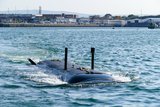
Screenshot from SH Defense video of containerised MCM solution. (Photo: SHD)
Modular payloads will include Kraken surveillance systems and SH container modules for offshore patrol vessels.


Canada-based Kraken Robotics is co-operating with Danish firm SH Defense (SHD) to design and sell containerised mine countermeasure (MCM) and other subsea surveillance payloads for the naval and commercial marine industries.
These modular payloads will include Kraken surveillance systems and SH container modules for offshore patrol vessels.
‘SH Defense will globally promote and sell containerised subsea surveillance solutions with a variety of Kraken’s surveillance solutions,’ Karl Kenny, Kraken president and CEO, said on 7 June.
He added: ‘In Canada, Kraken, supported by SHD, will promote, sell, deliver, install and service SHD hydraulic, electric and mechanical system modular containerised solutions to the Royal Canadian Navy, Canadian Coast Guard and commercial industry.’
These solutions could feature in the Harry DeWolf-class Arctic and Offshore Patrol Ships for the RCN and Canadian Coast Guard.
The use of containerised modules for MCM would reduce the need for preventative maintenance while also meaning that ships can remain in service when equipment requires servicing.
‘New systems can be installed on vessels by fitting them to a module, instead of refitting the entire ship,’ Kraken added, and when a ship is removed from service, the modules can be reused by other vessels.
Related Programmes in Defence Insight


More from Naval Warfare
-
![Five years on: where could opportunities emerge next for AUKUS Pillar II?]()
Five years on: where could opportunities emerge next for AUKUS Pillar II?
Payload commonality, combat systems and electronic warfare are emerging as likely priorities as the trilateral partnership balances building submarines with sharing industrial ecosystems.
-
![Singapore expands maritime presence with future-ready Sentinel OPV]()
Singapore expands maritime presence with future-ready Sentinel OPV
Singapore is building space for uncrewed systems and future technologies into its new Sentinel-class OPVs, reflecting a wider move towards adaptable vessels capable of maintaining persistent maritime presence.
-
![From the Baltic to the Gulf: where USV procurement is heading next]()
From the Baltic to the Gulf: where USV procurement is heading next
Saildrone’s new Copenhagen base is one sign of a larger shift, as navies globally turn to uncrewed vessels for surveillance and mine clearance.
-
![Israeli Navy looks to expand as war reshapes future force requirements]()
Israeli Navy looks to expand as war reshapes future force requirements
Israel’s navy is preparing for a larger and more technically diverse role, but its ambitions could be impacted by supply chain restrictions, accelerating demand for domestic naval production as well as autonomous maritime capabilities.
-
![Quantum sensing gathers pace as navies eye undersea advantage]()
Quantum sensing gathers pace as navies eye undersea advantage
As AI dominates defence conversations, industry increasingly points to quantum sensing as the technology set to change submarine and uncrewed underwater vehicle operations.