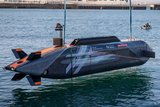
C-Worker 15 large USV displayed at Oceanology International 2024
L3Harris's new USV can carry a 10,000kg payload. (Photo: L3Harris)
L3 Harris has a list of USVs, including C-Worker 4, 5 and 6, which range in weight from 1,000kg to 4,500kg. Its latest system, C-Worker 15, weighs in at 14,500kg.


L3Harris unveiled its new C-Worker 15 large USV at the Oceanology International 2024 conference in London which will run until 14 March.
The vessel has been designed to carry a range of payload options and has a 10m x 4m aft deck, which can accommodate a 20ft intermodal container and a 10,000kg payload supplied with a baseline of 40kW of power.
A gondola mounting configurable for a wide range of sensors has been fitted to the vessel. Internally, it has space for four full-height 48cm (19in) racks for topside acquisition, processing and storage hardware in an environmentally controlled peak.
The C-Worker 15 has been designed specifically for the operation of towed sensors or ROV payloads (including fully autonomous launch and recovery), offering a low-emission solution for both military or commercial data acquisition.
The company stated the vessel has 21-day endurance, and has been optimised for towed sensor and Inspection Class ROV (Class II) operations. It was designed and built to the MCA Workboat Code as a Category 0 vessel for unrestricted service areas.
Defence applications include maritime domain awareness, ISR, insertion operations support, combat SAR, deterrence, close in force protection, swarm protection/operations and surface warfare.



More from Naval Warfare
-
![Canada assesses security equipment changes for Polar Icebreaker Imnaryuaq]()
Canada assesses security equipment changes for Polar Icebreaker Imnaryuaq
The Canadian Department of National Defence is evaluating communications and reconnaissance changes for CCGS Imnaryuaq’s expanded maritime security role, while retaining its 2032 acceptance target.
-
![US Navy’s MQ-25 Stingray approaches carrier-integration tests]()
US Navy’s MQ-25 Stingray approaches carrier-integration tests
Boeing has outlined its upcoming precision-landing and carrier-airspace trials as MQ-25 manufacturing shifts towards Illinois, with initial Lot 1 deliveries expected in 2029.
-
![From Poland to the Pacific: can Miecznik become a blueprint for other navies?]()
From Poland to the Pacific: can Miecznik become a blueprint for other navies?
Babcock is taking its Polish industrial partnership approach to Denmark and New Zealand as navies seek sovereign shipbuilding skills alongside ships.
-
![Unsettled waters in the North: can navies still trust their Arctic acoustic maps?]()
Unsettled waters in the North: can navies still trust their Arctic acoustic maps?
The changing Arctic environment is creating new challenges for submarine detection, driving demand for distributed sensors, uncrewed underwater vehicles and real-time acoustic modelling.