Brazil signs polar vessel contract
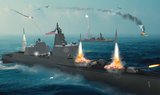
Mock-up of the NApAnt polar vessel for the Brazilian Navy. (Photo: Agência Marinha de Notícias Brazil)
Construction of the Navio de Apoio Antártico (NApAnt) is scheduled to begin this year.


The Brazilian Navy expects to receive by late 2025 a new polar support vessel (Navio de Apoio Antártico, or NApAnt), the service explained after a contract was signed on 13 June.
The new vessel will be built by a special-purpose entity called Polar 1 Construção Naval, which comprises two subsidiaries of Singapore-based SembCorp Marine (Brazil-based Estaleiro Jurong Aracruz shipyard and SembCorp Marine Specialised Shipbuilding).
In a 14 June statement, SembCorp Marine explained that the contract is worth about $150 million and was awarded by Emgepron, ‘a state-owned company linked to the Ministry of Defence in Brazil’.
According to SembCorp Marine,
Our news & analysis is now part of Defence Insight®
A Basic-level or higher Defence Insight subscription is now required to view this content.

More from Naval Warfare
-
![US Navy’s $275 billion BBGN plan hinges on shipyard transformation]()
US Navy’s $275 billion BBGN plan hinges on shipyard transformation
The US Navy’s planned nuclear-powered warship carries a US$275 billion price tag, but the greater story lies in the industrial overhaul needed to build it, from AI-enabled design to digital twins and modular construction.
-
![Industry sees opportunity in Australia’s shift to networked undersea warfare]()
Industry sees opportunity in Australia’s shift to networked undersea warfare
Australia’s new defence innovation strategy indicates a shift from platform-centric to network-centric undersea warfare, with Ocius and Anduril Industries pointing to fast-growing opportunities for local industry.
-
![Asia-Pacific emerges as the largest export market for US-made USVs]()
Asia-Pacific emerges as the largest export market for US-made USVs
Asian customers have placed one of the largest known international purchases of US-built uncrewed surface vessels, highlighting accelerating regional demand for autonomous maritime capabilities and distributed naval operations.