BAE Systems completes successful test of Mk 38 TLS
BAE Systems, Boeing, and the US Navy recently conducted a successful test of the Mk 38 MOD 2 Tactical Laser System (TLS) concept at Eglin Air Force Base in Eglin, Fla.
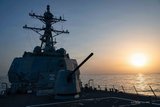
The Mk 38 TLS concept is a proposed high energy laser addition to the Mk 38 naval gun systems that are currently deployed on most surface combatants. The results of the recent field testing demonstrated a capability to identify and classify hostile targets and provide rapid hand-off to the Mobile Active Targeting Resource for Integrated Experiments (MATRIX) system for interdiction. The test system configuration fired against air and surface maritime targets, demonstrating a range of target effects.
Additionally, swarm tests were conducted to simulate an attack by a large number of fast, maneuvering small boats, intermingled with neutral boat traffic. These tests demonstrated a consistent ability to detect, track, classify and engage threat vessels at tactically relevant ranges.
“The success of this testing exceeded all expectations and demonstrates that our Mk 38 TLS has the potential to deliver an important ship self defense capability,” said Mark Signorelli, vice president and general manager of Weapon Systems for BAE Systems. “The optics associated with control of the laser allow significantly greater capability in target identification, the ability to conduct precision tracking and engagement, and provide the option of non-lethal engagements, which are critical features to enhance ship defenses.”
A distinguished visitor day was held on June 29 with representatives in attendance from US Fleet Forces, Naval Air Forces, Office of Naval Research, Office of the Chief of Naval Operations (OPNAV), Naval Sea Systems Command and other service and joint agencies. In addition to receiving briefs on the Mk 38 TLS concept and the MATRIX system, static and dynamic demonstrations were conducted to give the visitors a first-hand look at the system’s capabilities.
“The Mk 38 Tactical Laser System concept was able to discriminate specific target features while tracking fast moving small boats. It was able to engage precise targets with laser energy at tactically relevant ranges,” said Chris Abbott, Science Advisor for Commander, US Second Fleet.
For the test demonstration, BAE Systems partnered with Boeing and used the Air Force Research Laboratory (AFRL) MATRIX laser test bed and Boeing’s 10kW International Photonic Group (IPG) fiber laser. The demonstration was sponsored by the Commander of the US Second Fleet. Naval Surface Warfare Center Dahlgren was the Test Executive Agent and the USAF 46th Test Squadron coordinated all range and safety support.
Source: BAE Systems



More from Naval Warfare
-
![The UK joins the movement towards joint procurement]()
The UK joins the movement towards joint procurement
The UK will spend an estimated US$3.89 billion over the next decade in joint naval programmes, a lot of which will be in cooperation with Norway.
-
![Rheinmetall’s GMF 140: Ambitious frigate or market misfit?]()
Rheinmetall’s GMF 140: Ambitious frigate or market misfit?
Rheinmetall has unveiled its first next-generation frigate design, showing ambitions to compete as a surface combatant prime contractor. While the company is targeting North America, analysts believe the concept may be better positioned for future European programmes.
-
![US Navy $76.6bn award provides stability for submarine production]()
US Navy $76.6bn award provides stability for submarine production
The US Department of War’s US$76.6 billion Columbia-and Virginia-class submarine contract gives industry demand certainty as Washington seeks to rebuild its shipbuilding base.
-
![US Navy begins SPY-6(V)4 radar testing ahead of first Arleigh Burke destroyer backfit]()
US Navy begins SPY-6(V)4 radar testing ahead of first Arleigh Burke destroyer backfit
Wallops Island trials will validate the next-generation radar's combat system integration before its installation aboard USS Pinckney, the first Flight IIA destroyer to receive the SPY-6(V)4 upgrade.
-
![Hanwha Ocean deepens US ties and eyes Saudi submarine prospect after Canada setback]()
Hanwha Ocean deepens US ties and eyes Saudi submarine prospect after Canada setback
Hanwha Ocean is deepening ties with the US and eyeing a submarine opportunity in Saudi Arabia, as South Korea looks to convert its Canadian defeat into export momentum.