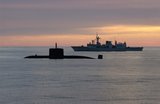
BAE Systems to work on MOCCA programme


The Defense Advanced Research Projects Agency (DARPA) has awarded BAE Systems a $4.6 million contract to develop technology to help submarines better detect other submerged vessels at greater distances, while minimising the risk of counter-detection, the company announced on 18 July.
Under the programme, known as the Mobile Offboard Clandestine Communications and Approach (MOCCA) programme, BAE Systems will carry out Phase 1 work to design efficient sonar capabilities to maximise detection ranges and improve target identification and tracking.
Geoff Edelson, director of maritime systems and technology at BAE Systems, said: ‘Advances in maritime technology are critical to the Department of Defense and an area where the US military can continue to strengthen its advantage.
‘With the resurgence of near-peer competitors and an increasing number of submarines, MOCCA technology will provide navy submariners with a vital asymmetrical advantage against a rapidly proliferating undersea threat.’



More from Naval Warfare
-
![Euronaval 2026: ‘I want to sell 31 Type 31s by 2031’ - CGO maps Babcock’s global push]()
Euronaval 2026: ‘I want to sell 31 Type 31s by 2031’ - CGO maps Babcock’s global push
Chief growth officer Sir Nick Hine tells Shephard how Babcock is lining up New Zealand, Chile, Denmark and the US for its Arrowhead 140 frigate, speaks on the hybrid navy offer and talks AUKUS.
-
![From Chokepoints to the Deep: ASELSAN’s Naval Vision at EURONAVAL]()
From Chokepoints to the Deep: ASELSAN’s Naval Vision at EURONAVAL
From deployable ship defence to autonomous sea and underwater vehicles, ASELSAN is preparing for a new era of naval security.
-
![Euronaval 2026: by the power of six, Fincantieri’s MMMV reflects modular naval shift]()
Euronaval 2026: by the power of six, Fincantieri’s MMMV reflects modular naval shift
The 50m, six-person ship from the Italian shipbuilder carries swappable, containerised payloads instead of a fixed mission, reflecting a shift that is becoming increasingly evident.
-
![Canada’s submarine availability under pressure as Chicoutimi is unlikely to return to front-line duties]()
Canada’s submarine availability under pressure as Chicoutimi is unlikely to return to front-line duties
HMCS Victoria and HMCS Windsor could return from their current deep maintenance, but unconfirmed operational timelines leave questions over patrol capacity before the first CPSP arrives.