HMAS Arunta receives new mast


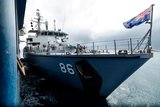
Royal Australian Navy Anzac-class frigate, HMAS Arunta, has received its new mast as part of its Mid Life Capability Assurance Program (AMCAP) being undertaken at BAE Systems Australia’s Henderson facility.
The new mast has been manufactured by BAE Systems as part of the Warship Asset Management Agreement between BAE Systems, SAAB Australia, Naval Ship Management and the Commonwealth of Australia.
The mast installation is one of the last major works on the ship ahead of its undocking before the end of 2018. The vessel will then undergo sea trials ahead of a planned return to service in 2019.
The new mast is taller and wider than the existing mast in order to accommodate the new CEA L-Band radar system, while retaining the existing anti-ship missile defence radar capability. The new L-Band radar capability will be integrated into the existing combat management systems of the ship by SAAB Australia.
Upon completion of the AMCAP, HMAS Arunta will have upgraded ventilation systems; new sewage systems; improvements to the control and monitoring system; engine modifications to improve power and efficiency; and a new communications suite.
The control and monitoring system of the ship has also received a technological enhancement, replacing existing analogue technology with digital. Integration of the communications system into the existing data communications systems has been closely managed during design by Leonardo.



More from Naval Warfare
-
![Competitive P17B tender marks a shift in Indian Navy frigate procurement]()
Competitive P17B tender marks a shift in Indian Navy frigate procurement
The Indian Navy's P17B programme is expected to combine greater weapons capacity with a competitive domestic construction model, although key systems could remain dependent on international supply chains.
-
![How France’s SNLE 3G programme is reshaping the naval nuclear industrial base]()
How France’s SNLE 3G programme is reshaping the naval nuclear industrial base
Extending far beyond a four-submarine replacement programme, France’s ballistic missile submarine effort is a decades-long industrial initiative designed to preserve the country’s ability to build and sustain nuclear-powered strategic platforms.
-
![Quantum Systems enters maritime domain with Baltic-focused USV and UUV]()
Quantum Systems enters maritime domain with Baltic-focused USV and UUV
Quantum Systems has launched into the maritime domain with Seavex and Subvex, aiming to close a Baltic Sea ISR gap opened by infrastructure sabotage.
-
![Suppliers await next step in Australia’s mine warfare transition]()
Suppliers await next step in Australia’s mine warfare transition
Australia’s mine countermeasure capability remains in flux as the Huon-class nears retirement, but accelerated investment in autonomous systems is opening a path for industry.
-
![Can the US Navy ask Indo-Pacific allies to do more while training with them less?]()
Can the US Navy ask Indo-Pacific allies to do more while training with them less?
As the Iran War draws US ships and marine corps units away from the Indo-Pacific, curtailed exercises and a temporary carrier gap are exposing tensions between Washington’s demand for more self-reliant allies and the joint training needed to realise that ambition.