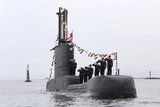
Australian companies signed for Attack class programme


Two Australian companies have been awarded contracts for the Royal Australian Navy’s Attack-class submarine programme.
Berendsen Fluid Power and H & H Machine Tools were selected for major equipment design contracts that will support the build of the new class of submarine.
The companies will partner with Pinette Emidecau Industries and Starrag Group Holding to become the design authority and manage the local manufacture of medium-capacity presses and a large-capacity milling machine.
Minister for Defence,Linda Reynolds said: ‘The awarding of these contracts supports the Morrison government’s objectives of providing sovereign support for the design, build, operations and sustainment of the fleet, as well as maximising the involvement of Australian industry.’
Related Equipment in Defence Insight

You may also like

More from Naval Warfare
-
![South Korea, Japan and Turkey vie for US shipbuilding access in future frigate contest]()
South Korea, Japan and Turkey vie for US shipbuilding access in future frigate contest
Washington’s search for a foreign-built frigate could hand South Korea, Japan and Turkey a larger prize than a double-hull order: a foothold inside the US shipbuilding industrial base.
-
![Japan’s FY2027 budget bets on stand-off systems to offset demographic decline]()
Japan’s FY2027 budget bets on stand-off systems to offset demographic decline
Japan’s FY2027 defence budget backs stand-off strike, a 17-aircraft MQ-9B buy and a declared bid to lead the world in uncrewed maritime assets, alongside new frigates, submarines and support ships.
-
![Russia’s uncrewed boat portfolio hints at future naval demand]()
Russia’s uncrewed boat portfolio hints at future naval demand
Ukrainian intelligence has catalogued more than 20 Russian uncrewed surface vessels, revealing a portfolio weighted towards mine warfare and logistics, with implications for Western naval investment.
-
![Ukraine’s new long-range 12m autonomous vessel can deploy other drones]()
Ukraine’s new long-range 12m autonomous vessel can deploy other drones
Ukraine’s UForce unveiled the MV11 uncrewed surface vessel, designed to launch and support other naval drones at sea, fuelling debate over the future of autonomous maritime task groups.
-
![Global submarine suppliers compete for a rapidly shrinking market]()
Global submarine suppliers compete for a rapidly shrinking market
Diminishing submarine competitions worldwide are leaving fewer acquisition opportunities, pushing contractors toward alternatives.