Airbus wins €480 million contract to build communications network for French air and naval forces
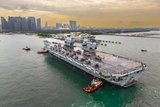
The RIFAN 3 network will be deployed across more than 80 French navy and air force vessels. (Photo: Airbus)
The IP Network, named RIFAN 3, will build on the work of previous RIFAN 2 network, with development work carried out on the new system between 2026 to 2030.


Airbus Defence and Space has been awarded a contract by the French Defence Procurement Agency (DGA), alongside France-based naval contractor Naval Group, to build a communications network for the French air and naval forces.
The contract has a maximum value of €480 million (US$503 million) and covers the next 10 years. Work on the IP Network of the Naval Force (RIFAN) 3 will cover the development, upgrade, deployment and operational maintenance of the communication network.
Development will be carried out between 2026 and 2030, according to Airbus, and deployed on ships between 2028 and 2032.
More than 80 vessels will be equipped with RIFAN 3 network, including aircraft carriers, frigates, patrol vessels, submarines and amphibious helicopter carriers.
Eric Even, head of space digital at Airbus Defence and Space, said: “With RIFAN 3, we are preparing for the next stage, that of collaborative naval combat, networked combat of all assets and platforms involved in naval operations.”
The RIFAN 2 system was commissioned by Airbus and the French Navy between 2012 and 2016. This new contract aims to increase inter-ship connectivity and, according to Airbus, meet the needs to collaborative combat – deployed on front-line vessels.


More from Naval Warfare
-
![US Navy begins SPY-6(V)4 radar testing ahead of first Arleigh Burke destroyer backfit]()
US Navy begins SPY-6(V)4 radar testing ahead of first Arleigh Burke destroyer backfit
Wallops Island trials will validate the next-generation radar's combat system integration before its installation aboard USS Pinckney, the first Flight IIA destroyer to receive the SPY-6(V)4 upgrade.
-
![Hanwha Ocean deepens US ties and eyes Saudi submarine prospect after Canada setback]()
Hanwha Ocean deepens US ties and eyes Saudi submarine prospect after Canada setback
Hanwha Ocean is deepening ties with the US and eyeing a submarine opportunity in Saudi Arabia, as South Korea looks to convert its Canadian defeat into export momentum.
-
![A400M trial demonstrates airborne deployment of uncrewed surface vessel]()
A400M trial demonstrates airborne deployment of uncrewed surface vessel
Kraken Technology Group’s A400M airdrop of a K3 Scout uncrewed surface vessel points to a new way for navies to insert USVs into contested waters, bypassing ports and motherships.
-
![Babcock onshores 85% of Canada’s submarine supply chain as it eyes future CPSP programme]()
Babcock onshores 85% of Canada’s submarine supply chain as it eyes future CPSP programme
By moving most of the Royal Canadian Navy’s submarine supply chain into Canada, Babcock Canada is driving to strengthen sovereign sustainment capabilities while preparing to compete to maintain the future Canadian Patrol Submarine Project.
-
![From the seas to the web: the changing shape of UK defence in Southeast Asia]()
From the seas to the web: the changing shape of UK defence in Southeast Asia
As his final engagement before leaving his post as the head of the British defence staff for Southeast Asia and defence adviser to Singapore, Brigadier Eddie Maskell-Pedersen spoke with Shephard about maritime security, cyber cooperation and long-term partnerships.