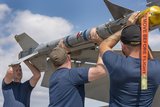
USMC tests M320 grenade launcher


The US Marine Corps is testing the M320 grenade launcher module at Camp Lejeune, North Carolina, the corps announced on 9 June.
One of the first USMC unit to be issued with the M320 - Bravo Company, 2nd Combat Engineer Battalion - is carrying out the firing and handling testing. The M320 has already been in use with the US Army.
The M320 offers a number of capabilities superior to that of its predecessor, the M203. The M320 can be fired as a separate weapon system without being attached to a host weapon, and the sights on the M320 are more user friendly and flexible, increasing the chances of the projectile landing on target with the first shot.
Loading of the M320 barrel from the side allows for longer projectiles with increased velocity. This is different from the M203, which limits the size of projectiles the operator can use, due to the placement of the barrel on the bottom of the weapon system.
The M320 is designed to engage groups of enemy personnel, vehicles, bunkers, provide suppression and obscuration on objectives and mark targets to aid in direct fire. The weapon allows maximum coverage in sectors of fire that direct-fire weapons cannot engage.
Related Equipment in Defence Insight



More from Land Warfare
-
![Snow patrol and access all areas: the Arctic all-terrain vehicles market grows]()
Snow patrol and access all areas: the Arctic all-terrain vehicles market grows
The procurement and planned procurement of articulated tracked all-terrain vehicles is being driven by a need to replace older platforms and an acknowledgement of a capability gap for Arctic regions.
-
![Push strengthens for a second JLTV supplier]()
Push strengthens for a second JLTV supplier
A move, launched in May, could lead to a second supplier for the US Marines Corps’ Joint Light Tactical Vehicle requirement. Meanwhile, Wisconsin elected representatives have been pushing for necessary funding to be included in the FY27 budget.
-
![Canada reveals first requirements for future long-range air-to-air missile]()
Canada reveals first requirements for future long-range air-to-air missile
Exclusive: Ottawa says its future NORAD interceptor must be highly stealthy, resistant to jamming and capable of engaging threats at very long range, while leaving the competition open to domestic and international suppliers.