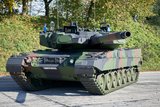
USMC ACV 1.1 programme inches forward


The Marine Corps’ Amphibious Combat Vehicle (ACV) 1.1 programme is gaining pace with bids submitted by competing companies for initial low-rate production.
SAIC‘s programme bid was submitted on the 3 January, with BAE Systems following suit on the 9 January.
After each delivering 16 prototypes for the development and testing, both companies are now competing for their 8x8 vehicle designs to be down-selected in June for initial production.
The contract, expected to be valued at $1.1 billion, will be awarded to a single company to produce 204 vehicles by 2020 while the second increment of the programme, ACV 1.2,
Our news & analysis is now part of Defence Insight®
A Basic-level or higher Defence Insight subscription is now required to view this content.


More from Land Warfare
-
![AUSA 2026: AM General boss confirms 300-plus JLTV A2s delivered as export orders approach]()
AUSA 2026: AM General boss confirms 300-plus JLTV A2s delivered as export orders approach
The Joint Light Tactical Vehicle programme for the US Marine Corps appears to be making progress, with AM General increasing production of its version while Oshkosh Defense has secured long-lead materials in anticipation of becoming a second supplier.
-
![AUSA 2026: BAE Systems pushes air defence capability with two new demonstrators]()
AUSA 2026: BAE Systems pushes air defence capability with two new demonstrators
The company's new artillery demonstrator is intended to engage incoming missiles and ground targets, while a separate microwave system focuses on uncrewed aerial threats.
-
![AUSA 2026: Textron shows upgraded Commando Select as it seeks exports beyond Ukraine]()
AUSA 2026: Textron shows upgraded Commando Select as it seeks exports beyond Ukraine
The latest Commando Select configuration incorporates improvements to its powerpack and suspension, with the first of 65 vehicles destined for Ukraine expected to be delivered in early 2027.
-
![AUSA 2026: Northrop Grumman targets lower-cost air defence with $100 million Raid Hunter investment]()
AUSA 2026: Northrop Grumman targets lower-cost air defence with $100 million Raid Hunter investment
At AUSA 2026, Northrop Grumman revealed it had invested US$100 million in its Raid Hunter gun-based air defence capability, which the company claims could reduce the cost of individual engagements by 95.5% compared with interceptor missiles.
-
![Active protection systems: from optional upgrade to operational requirement]()
Active protection systems: from optional upgrade to operational requirement
As battlefield threats multiply, active protection systems are becoming increasingly important for armoured vehicle survivability – but cost, integration challenges and evolving drone threats will determine how widely they can be deployed.