US delivers mortar radars, training to Ukraine
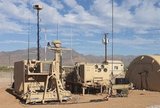
The US Army has delivered lightweight counter-mortar radars for the Ukrainian Army and performed mortar round tracking training, it has been announced.
A US army team, which included two Tobyhanna army depot technicians, spent two weeks at the international peacekeeping and security centre in Yavoriv, Ukraine. During this time, they trained Ukrainian soldiers to deploy, operate and troubleshoot the radars.
The training included classroom instruction, hands-on equipment assembly and disassembly, tactical deployment and emplacement. The team taught a cadre of Ukraine army officers how to use the radars.
Ed Mickley, a depot spokesman, US army, said: ‘Practical real-world experience was the focus of the radar training.’
The counter-mortar radars, which backtrack incoming mortar rounds, are the first to be delivered so that the Ukrainian armed forces can be trained on their use. They are part of a $118 million equipment and training commitment by the US to assist the Ukrainian armed forces.
Electronics technicians at the depot’s production engineering directorate had to modify the radars to accept the standard 220V electrical power supply in Europe.



More from Land Warfare
-
![Polaris expands Arctic mobility offering as US military orders grow]()
Polaris expands Arctic mobility offering as US military orders grow
The Military 850 Voyageur 155 Crossover has secured orders from the US Army, Air Force and Marine Corps, addressing demand for agile Arctic mobility with passenger, cargo and towing capacity.
-
![More bidders move onto starting grid for British Army Land Rover replacement programme]()
More bidders move onto starting grid for British Army Land Rover replacement programme
The Light Mobility Vehicle segment of the UK’s Land Mobility Programme for the British Army may actually be about to make progress, or at least likely bidders seem to think so. Shephard spoke with several contenders who revealed their views on how the army should replace the ageing fleet.
-
![UK’s ground-based air defence effort remains in assessment phase after third industry day]()
UK’s ground-based air defence effort remains in assessment phase after third industry day
The UK’s plan to introduce a new air defence capability into the British Army will cover short and medium-range defence as well as counter-uncrewed aerial system systems. Timelines are not yet laid out but industry is making plans.