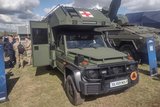
Lithuania requests Stryker sale


The US state department has approved a potential foreign military sale to Lithuania for Stryker Infantry Carrier Vehicles (ICV) and associated equipment, parts and logistical support, it was announced on 5 November.
The government of Lithuania has requested 84 M1126 Stryker ICVs to fill a capability gap in its land forces not currently addressed. It will also enhance the country’s ability to support NATO and coalition operations.
Armament requested includes the ATK 30mm cannon, the XM813 30mm cannon or a European variant with Remote Weapon Station and 84 M2 Flex Machine Guns.
Additionally, Lithuania has requested the ICV-30 package, including contractor logistics support, support equipment, spare parts, armaments, two AN/PRC-152 Radios per vehicle, one AN/PSN-13 DAGR per vehicle, one VIC-3 per vehicle, training aids/devices/simulators and simulations (TADSS), translated technical manuals with laptop computers, training, Foreign Service Representatives (FSRs), OCONUS Contractor vehicle de-processing services and technical assistance.
The total estimated value of the deal is $599 million.
Related Equipment in Defence Insight


More from Land Warfare
-
![British Army's open plan draws diverse offerings for Land Rover replacement]()
British Army's open plan draws diverse offerings for Land Rover replacement
The UK Ministry of Defence has avoided being prescriptive in its search to replace the British Army’s Land Rover, meaning vehicle types being offered range from Land Rover Defender Wolf II and Humvee to the hybrid series Fering Pioneer. What does this mean for the procurement process?
-
![DVD 2026: British Army’s Ajax back in the hands of users as part of a gradual return]()
DVD 2026: British Army’s Ajax back in the hands of users as part of a gradual return
The introduction of Ajax vehicles into British Army service was stopped after operator health issues were reported during an exercise, but manufacturer General Dynamics Land Systems UK believes work over the past 10 months has dealt with the problems.
-
![Europe commits to long-range fires but countries move in different directions]()
Europe commits to long-range fires but countries move in different directions
Sweden, Croatia and France are pursuing different rocket artillery solutions as European armies seek greater reach, survivability and industrial resilience.