


Companies downselected for British Army vehicle programme
It is believed that three companies did not make the downselect but a dark horse in Spain’s Iturri is believed to have got through.


A team headed by Calytrix Technologies will supply the US Army with a next-generation game-based training technology called the Virtual Battlespace 3 (VBS3) simulation product. The five year contract was awarded under the army’s ‘Games for Training’ (GFT) programme.
The team includes Calytrix, Bohemia Interactive Simulations (BISim), SimCentric and Alelo.
VBS2 was originally delivered for the US Army’s Game After Ambush (GAA) contract in 2009. Since then, the product has been continuously improved with new enhancements, and new game engine features included in the new VBS3.
With an emphasis on re-use and open standards, VBS3 is a further step towards a common virtual environment for use across all aspects of military simulation. VBS3 is backwards compatible to facilitate re-use of VBS2 scenarios and content, and will run on hardware compatible with VBS2.
In addition to VBS3 being delivered to the US Army, it will also be provided as a normal software update to the US Marine Corps, both the Australian and New Zealand defence forces, the Canadian armed forces, the Netherlands Ministry of Defence and the Swedish armed forces. VBS3 will also be provided to industry partners with a valid Virtual Battlespace Developer Network (VBSDN) subscription at the time VBS3 is released worldwide, which is expected to be in early 2014.
Peter Morrison, CEO, BISim, said: ‘BISim is committed to serving the US military, and we are confident that the new capability in VBS3 will serve the US Army superbly. We are very excited and honoured to be part of the Calytrix Team, delivering the VBS3 platform to the US Army as its new flagship game-based training tool.’


It is believed that three companies did not make the downselect but a dark horse in Spain’s Iturri is believed to have got through.
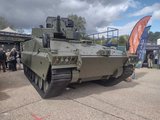
Air defence and counter-drone weapons continue to be developed, tested and demonstrated in anticipation of growing demand, with most solutions designed to be platform-agnostic and readily integrated onto suitable platforms.

The US Army began its search for a 155mm tracked mobile tactical cannon in an effort that Shephard forecasts could be worth billions of dollars. Meanwhile, the UK DVD exhibition saw companies showcase their offerings for the British Army’s mobility and air defence requirements.

The development demonstrates how the platform could provide additional firepower and growth potential while the US Army progresses its long-term replacement for the Bradley.

FNSS and PT Pindad are progressing the Indonesian tracked armoured personnel carrier programme as local production gets under way.

Firing trials of the Tulpar and Leonardo Hitfact Mk II combination follow an integration programme covering mechanical, electrical, electronic and software interfaces.

Connect with us on socials


