


Tulpar firing trials expand Hitfact Mk II platform options
Firing trials of the Tulpar and Leonardo Hitfact Mk II combination follow an integration programme covering mechanical, electrical, electronic and software interfaces.


Cubic Defense Applications has announced that it has received a new order from the US Army’s Program Executive Office for Simulation, Training and Instrumentation (PEO STRI) for its Instrumentable MILES Tactical Vehicle Systems (I-MILES TVS). The $12.5 million order was announced on 18 December.
I-MILES TVS uses Cubic’s wireless vehicle Multiple Integrated Laser Engagement System (MILES) technology to provide the real-time casualty assessment necessary for MILES tactical engagement training in direct-fire, force-on-force instrumented training scenarios.
According to Cubic, the system offers advanced performance because of its weapon simulation and casualty assessment accuracy for vehicles and fixed structures. It is adaptable to any wheeled or tracked tactical vehicle and is also configurable for buildings, fixed equipment and other structures. The system also includes new features that significantly improve ease of use for soldiers, including touch-screen displays with highly intuitive graphic interfaces.
The company recently completed shipment of more than 1,000 I-MILES TVS kits to the US Army. The first six tactical vehicle systems went to Fort Carson, Colorado, where they will be used to train end users.
Cubic is to deliver over 3,000 systems under the first option of its 2010 contract with the US Army’s PEO STRI. Cubic will conclude deliveries under the first option in May 2013, then commence work on a second option, which includes the $12.5 million order.

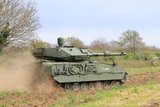
Firing trials of the Tulpar and Leonardo Hitfact Mk II combination follow an integration programme covering mechanical, electrical, electronic and software interfaces.

The news from Ukraine has again shown that antitank minefields and other obstacles on the battlefield, such as deep trenches, can play a key role in both offensive and defensive operations. Given this, there will always be a need to clear them, both during and after a conflict.
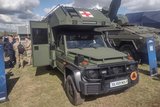
The UK Ministry of Defence has avoided being prescriptive in its search to replace the British Army’s Land Rover, meaning vehicle types being offered range from Land Rover Defender Wolf II and Humvee to the hybrid series Fering Pioneer. What does this mean for the procurement process?

The introduction of Ajax vehicles into British Army service was stopped after operator health issues were reported during an exercise, but manufacturer General Dynamics Land Systems UK believes work over the past 10 months has dealt with the problems.

Sweden, Croatia and France are pursuing different rocket artillery solutions as European armies seek greater reach, survivability and industrial resilience.

The bilateral agreement between the UK and Estonia comes as both countries explore how dispersed troops, drones, digital targeting, anti-tank weapons and increasingly long-range fires can complement the combat mass traditionally provided by heavy armour.

Connect with us on socials


