US Army exhibits Quantum’s hybrid military vehicle
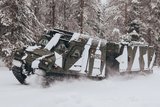
Quantum Fuel Systems Technologies Worldwide, Inc., announced today that its hybrid electric Clandestine Extended Range Vehicle (CERV), developed for and in cooperation with the US Army Tank Automotive Research Development and Engineering Center (TARDEC), is on display at the US Army Exhibit booth at the 10th Anniversary National Conference of the Hybrid Truck Users Forum (HTUF) in Dearborn, Michigan Sept. 28-30th.
Quantum designed, developed and manufactured the highly efficient and powerful CERV specifically as an advanced military scout vehicle that is intended for rapid, covert ingress and egress operations during reconnaissance, surveillance, and target-designation missions. The CERV features Quantum’s lightweight chassis and a new all-wheel-drive, diesel hybrid electric powertrain that produces in excess of 5000 lb·ft (6780 N·m) of maximum torque. The CERV is certified for flight on a number of military aircraft and is also the only hybrid vehicle currently certified for transport in the Osprey rotorcraft. The CERV incorporates Quantum’s Q-Force drivetrain, which was developed by Quantum in its Lake Forest Advanced Vehicle Concepts Center. The CERV can maintain speeds of 80 mph (129 km/h) and climb 60% grades-all while using up to 25% less fuel than conventional vehicles of comparable size.
“We are pleased and excited that the US Army is showcasing the Quantum CERV at this powerful industry forum,” said Alan P. Niedzwiecki, President and CEO of Quantum.
The Q-Force drivetrain, a variant of Quantum’s Q-DriveTM drivetrain, is optimized for use with an efficient diesel (JP8) engine and configured to achieve 60% grades, can ford up to 30” of water, and other unique military requirements. The Q-Force is a series hybrid design which utilizes a 1.4 liter diesel engine mated to a 75kW generator. This is combined with power from a lithium ion battery pack to energize the vehicle’s 100kW permanent magnet drive motor. The diesel hybrid design is unique in US light duty vehicles with nearly all other hybrids operating on gasoline. The Q-Force system takes advantage of the very high efficiency diesel engine to enable a high performance vehicle while achieving excellent fuel economy.
Source: Quantum



More from Land Warfare
-
![Trans-European iMUGS2 uncrewed systems programme set for three-day exercise in 2028]()
Trans-European iMUGS2 uncrewed systems programme set for three-day exercise in 2028
The next stage of the Integrated Modular Unmanned Ground System (iMUGS) programme, dubbed iMUGS2, was launched in November 2025. Three major demonstrations are planned before the end of 2028.
-
![How joint ventures are expanding Rheinmetall's munitions portfolio (video)]()
How joint ventures are expanding Rheinmetall's munitions portfolio (video)
Roman Köhne, CEO of Rheinmetall's Weapon and Ammunition Division, discusses the company's announcements at Eurosatory 2026, including developments in defence technology, precision systems, industrial partnerships and future capability programmes.
-
![Push strengthens for a second JLTV supplier]()
Push strengthens for a second JLTV supplier
A move, launched in May, could lead to a second supplier for the US Marines Corps’ Joint Light Tactical Vehicle requirement. Meanwhile, Wisconsin elected representatives have been pushing for necessary funding to be included in the FY27 budget.