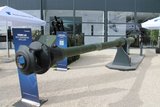
UK Scout SV turret undergoes live firing tests
Less than 11 months after the UK Scout / Specialist Vehicle (SV) Demonstration Phase contract was signed, the Industry Team led by General Dynamics UK has demonstrated impressive progress on the programme. The Team has conducted live-fire tests of the new Cased Telescoped (CT40) cannon system integrated in the very first Scout SV Turret, five months ahead of schedule.
This key maturity milestone was achieved with the firing of the integrated CT40 main weapon system on Wednesday 18th May at the Rheinmetal Landsysteme facility in Gersthofen, Germany as part of the SV programme for which General Dynamics UK is the overall Prime contractor and Lockheed Martin UK is the Turret system Design Authority.
The live firing was attended by Roddy Malone, Scout SV Team Leader at MoD, Steve Rowbotham, Vice President of General Dynamics UK, and representatives from CTA International, Rheinmetal Landsysteme, Curtiss Wright, Lockheed Martin UK and General Dynamics UK. The Turret system will now be delivered to Lockheed Martin UK in June 2011 for further system integration and testing at Ampthill, Bedfordshire.
Roddy Malone said “This was a very impressive event so soon after contract award. It is of value not only to the UK MoD but also to the French Government as the CTAI Cannon is being jointly qualified for both nations. The efforts of all involved have been magnificent.”
Brigadier Mike Riddell-Webster, Head of Capability for Ground Manoeuvre welcomed the news, commenting, “The Army is very pleased to note such progress on one of its highest priority equipment programmes.”
“The successful live-firing of the fully integrated CT40 cannon system into the first Scout SV Turret is yet another example of the SV Demonstration phase moving forward at pace,” said Steve Rowbotham.
“SV will not only deliver innovation to the British Army in Scout and its other variants, it will also deliver the best protection, technology and fightability ever seen in a vehicle of this type.”
“The Scout SV Turret Structure is a key programme for Rheinmetall Landsysteme” said Andreas Riedel, Head of the Rheinmetall Landsysteme Infantry and Artillery Business. “The achievement of the first firing from a new turret so soon after the award of the contract is the result of excellent co-operation from all of the companies involved.”
The Scout reconnaissance vehicle will be a key variant in the British Army’s operational SV fleet when it goes into service. It will serve alongside other SV variants including Protected Mobility, Repair and Recovery vehicles, all designed upon on the common-base platform being developed by General Dynamics UK.
The innovation of a 1.7 meter turret ring means that the Scout turret is designed to maximise space for the soldiers inside, thereby optimising fightability. This gives soldiers considerable room for modern display screens, comfort for long periods inside the turret and ease of movement, even wearing full body armour. With the need for military electronics ever-expanding on operations, the open electronic architecture allows significant growth for upgrade.
British troops using the Scout SV will have the best protection available in this vehicle class, both as it is delivered and as it grows to meet future threats. The vehicle will be immediately capable of delivering load-carrying growth potential of up to 42 tonnes thanks to a modern, proven drivetrain. This means that SV is capable of being equipped to meet future threats likely to appear over its entire 30 year life, without the need to upgrade its engine or transmission during that time.
Source: General Dynamics




More from Land Warfare
-
![Rheinmetall advances longer 155mm ordnance with 30% range increase]()
Rheinmetall advances longer 155mm ordnance with 30% range increase
Rheinmetall has begun initial firing trials of a new 155mm/60-calibre artillery ordnance that could deliver up to 30% greater range than its existing 155mm/52-calibre system, as production of the current gun expands across Germany and the UK.
-
![Trans-European iMUGS2 uncrewed systems programme set for three-day exercise in 2028]()
Trans-European iMUGS2 uncrewed systems programme set for three-day exercise in 2028
The next stage of the Integrated Modular Unmanned Ground System (iMUGS) programme, dubbed iMUGS2, was launched in November 2025. Three major demonstrations are planned before the end of 2028.
-
![How joint ventures are expanding Rheinmetall's munitions portfolio (video)]()
How joint ventures are expanding Rheinmetall's munitions portfolio (video)
Roman Köhne, CEO of Rheinmetall's Weapon and Ammunition Division, discusses the company's announcements at Eurosatory 2026, including developments in defence technology, precision systems, industrial partnerships and future capability programmes.