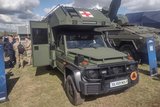
UK MoD signs on for 200 Force Protection Ocelot vehicles
Force Protection Europe, a Force Protection, Inc. group company, today announced that it has signed a contract with the UK Ministry of Defence (MoD) to supply an order of 200 Ocelots and an initial spares package for the Light Protected Patrol Vehicles (LPPV) program. The contract is valued at approximately £180 million (approximately US $280 million) with delivery of the vehicles scheduled to begin in the second half of 2011 and be completed by spring 2012.
The announcement means that Force Protection Europe’s unique new light protected patrol vehicle can now lay claim to two important industry firsts. The Ocelot will be the first ever British designed and built protected patrol vehicle to include a fully composite pod to protect the occupants. This innovative module has been developed by drawing on technology from the motorsports industry.
Ocelot will also be the first British military vehicle to accommodate the MoD’s new Generic Vehicle Architecture (GVA) requirements. The objective of the GVA project is to create a single, standard digital electronic and electrical architecture for UK vehicles that will enable crew to manage power and handle data efficiently on the vehicle, and for the vehicle to be easily adapted when the need arises.
Designed, developed and built in the UK by survivability specialist Force Protection Europe and automotive specialist Ricardo plc, together with Team Ocelot partners Thales, QinetiQ, Formaplex, DSG and Sula, the Ocelot is the most highly protected and agile vehicle of its size and weight that is available today. A clean sheet design, the Ocelot has undergone more than 12 months of rigorous blast and mobility testing before being chosen by the MoD.
David Hind, Managing Director, Force Protection Europe, said, “We are absolutely delighted to be awarded this important contract. Ocelot is a step change in protected mobility for this weight and class of vehicle and I am confident that it will be used to great effect in Afghanistan and any future operations. My number one priority now is to ensure that these vehicles are delivered to the MoD within the agreed timeframe. We are fully geared up to achieve this.”
Michael Moody, Chairman and Chief Executive Officer of Force Protection, Inc., said, “We are pleased to have completed the contract negotiations to supply our Ocelot vehicle for the UK forces. We believe that our success in the LPPV program gives the Ocelot significant credibility and will be a catalyst for opportunities in the US and other markets around the world, including in Australia where we are pursuing a contract to manufacture up to 1,300 next-generation protected mobility vehicles under the ‘Land 121 Phase 4’ program.”
Source: Force Protection
Follow Shephard News on Twitter






More from Land Warfare
-
![British Army's open plan draws diverse offerings for Land Rover replacement]()
British Army's open plan draws diverse offerings for Land Rover replacement
The UK Ministry of Defence has avoided being prescriptive in its search to replace the British Army’s Land Rover, meaning vehicle types being offered range from Land Rover Defender Wolf II and Humvee to the hybrid series Fering Pioneer. What does this mean for the procurement process?
-
![DVD 2026: British Army’s Ajax back in the hands of users as part of a gradual return]()
DVD 2026: British Army’s Ajax back in the hands of users as part of a gradual return
The introduction of Ajax vehicles into British Army service was stopped after operator health issues were reported during an exercise, but manufacturer General Dynamics Land Systems UK believes work over the past 10 months has dealt with the problems.
-
![Europe commits to long-range fires but countries move in different directions]()
Europe commits to long-range fires but countries move in different directions
Sweden, Croatia and France are pursuing different rocket artillery solutions as European armies seek greater reach, survivability and industrial resilience.