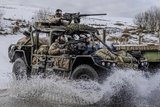
Supacat completes the 7th SPV400 Lightweight Protected Patrol Vehicle
Supacat has recently completed the 7th all-new, all-British Supacat SPV400, which is Supacat’s offering to win a UK Ministry of Defence £200 million Urgent Operational Requirement for a Light Protected Patrol Vehicle (LPPV) to replace the Snatch Land Rover. Following completion, the vehicle was delivered to the MoD in order for trials to be conducted prior to the announcement of preferred bidder, expected to be made soon.
Supacat’s rapid development of the SPV400 has seen all 7 vehicles built since December 2009. Vehicle 1 was blast tested in December 2009, vehicles 2&3 were delivered to the MoD for evaluation in January 2010 and were subsequently subjected to further trials by the MoD in April. Vehicles 4, 5 and 6 were blast tested in May, June and July respectively. Concurrently, vehicle 2 has been running back to back round the clock trials in operational conditions and vehicle 1 has been subjected to a demanding static four-poster rig test returning some impressive accelerated reliability results against repeated battlefield missions. Subsequently, vehicle 7 has been built to the very latest configuration and has had all of the upgrades and improvements incorporated as a result of the lesson learned throughout the development period. As a result, this vehicle is close to production standard.
“We are very proud of the progress we have made throughout this demanding development programme. Supacat has a reputation for being agile and for possessing the ability to deliver quality solutions in exceedingly short timescales; our development of SPV400 has clearly underwritten that reputation. SPV400’s design maturity is now advanced and this latest vehicle is already demonstrating that by delivering improved capability and reliability on trial”, said Nick Ames, Managing Director, Supacat Ltd. “The Supacat/NP Aerospace team believe it offers the best and a British solution - the SPV400. Its selection for LPPV would strengthen the UK’s innovation and engineering skills base and support manufacturing jobs, sustaining between 1000 and 1200 jobs throughout the UK. The SPV400 is an entirely British Export and will have a potentially huge international market should it succeed in the LPPV competition”.
Purpose designed to protect British troops from the threat of Improvised Explosive Devices in Afghanistan and perform patrol tasks in areas inaccessible to heavier vehicles, the Supacat SPV400 offers unprecedented levels of mobility and protection. This combination breaks new ground in military vehicle technology for a light patrol vehicle in the 7.5 ton class. Carrying a crew of six (2 +4), the SPV400 combines an integrated blast and ballistic protection system, including a protected all composite crew pod and V-shaped hull. On the desert plain it can reach speeds up to 80mph, comparable to the Supacat designed `Jackal`.
Over 90% of the SPV400 is UK sourced with a 30 strong supply chain stretching from Darlington, where Cummins UK produce the engine, down to Devon, where the SPV400 is designed by Supacat. Half of the key suppliers are concentrated in the West Midlands around NP Aerospace’s Coventry production facility where the SPV400 will be built. They include GKN Aerospace and GKN Driveline, Pailton Engineering, CSES Engineering, Park Sheetmetal Ltd, Garforth & Goodman, Christy Hydraulics, Dana UK Axles, AFS Ltd, Lighting Aerospace.
Source: Supacat




More from Land Warfare
-
![Europe commits to long-range fires but countries move in different directions]()
Europe commits to long-range fires but countries move in different directions
Sweden, Croatia and France are pursuing different rocket artillery solutions as European armies seek greater reach, survivability and industrial resilience.
-
![Polaris expands Arctic mobility offering as US military orders grow]()
Polaris expands Arctic mobility offering as US military orders grow
The Military 850 Voyageur 155 Crossover has secured orders from the US Army, Air Force and Marine Corps, addressing demand for agile Arctic mobility with passenger, cargo and towing capacity.
-
![More bidders move onto starting grid for British Army Land Rover replacement programme]()
More bidders move onto starting grid for British Army Land Rover replacement programme
The Light Mobility Vehicle segment of the UK’s Land Mobility Programme for the British Army may actually be about to make progress, or at least likely bidders seem to think so. Shephard spoke with several contenders who revealed their views on how the army should replace the ageing fleet.