Layered protection: How air defence is adapting to rising drone and missile threats (podcast)
A surge in aerial threats – from advanced missiles to low-cost drones – is reshaping the way militaries approach air defence, driving demand for flexible, multi-layered solutions.


Brought to you in partnership with Rafael
Listen on Apple Podcasts, Amazon Music, Spotify and more.
The conflicts in Ukraine and the Middle East have demonstrated the growing complexity of modern air defence, with multiplying threats ranging from sophisticated cruise missiles to cheap drones. For Rafael, a multi-layered approach is the key to protecting militaries and wider populations in today’s battlespace.
Retired Brigadier General Shachar Shohat is a former commander of Israel’s Air Defence Forces and is now Vice President (VP) – Strategy And Business Development at Rafael.
Brig Gen Shohat outlined an increasingly complex environment, with threats ranging from fixed-wing aircraft and helicopters to unmanned platforms, ballistic missiles, rockets and mortars, and most recently the explosion of inexpensive drones.
“The threat has stretched from very low speed to hypersonic speed, from a very low altitude to the highest level, even out of the atmosphere,” Brig Gen Shohat explained. “Past threats like aircraft are still relevant, but you have to deal with all these threats simultaneously – that has made the battlefield more complicated than ever.”
No silver bullet
Gideon Weiss, Rafael’s VP of Business Development and Marketing, said that air defence concepts are changing, influenced by pressing operational needs. While the precise response will differ depending on geography and national needs, “it’s clear that there’s no silver bullet”.
In this context, an open architecture is vital, he said, combined with stockpiles of different interceptors to protect against a multiplying array of dangers.
“If you don't have stockpiles of interceptors to protect your skies, that becomes a problem. A lot of nations are looking at similar threats but are looking at different types of solutions, because not everyone has their own stockpiles and technologies at their disposal.”
Israel’s Iron Dome air defence system – developed by Rafael – was the focus of international attention during the recent Middle East conflict, particularly during the Iran-Israel War in June 2025.
There is no ‘one size fits all’ solution when it comes to air defence, with security depending on a mixture of systems, munitions and capabilities. “That multi-layered approach gives you the redundancy you need to mitigate the challenge,” explained Brig Gen Shohat.
When dealing with large ballistic missile salvos or swarms of drones, “you need to adapt different solutions to different threats to make sure that you have the best chances to intercept those threats,” he added.
However, there is a critical balance to strike between the economic equation and interceptor capabilities. “You don’t want to waste munitions and money [by deploying] high-end technology and very expensive munitions to mitigate a challenge that is very simple and stupid.”
Technology is evolving to provide this multi-layered capability, Weiss noted, pointing to the increasing adoption of high-energy laser weapon systems (HELWS) like Rafael’s Iron Beam. Such systems offer an essentially unlimited magazine at almost no cost per interception, while providing the ability to quickly engage and neutralise an array of threats at different ranges.
“Lasers are not just adding capabilities, but also provide an opportunity to save interceptors,” explained Weiss.
A dialogue between offence and defence
The changing security environment in Europe, the Middle East and other regions has naturally impacted perceptions around air defence, Weiss noted.
“The guillotine sharpens the mind,” he said. “When there is an imminent threat, when you see these masses of ballistic missiles, cruise missiles, UAVs and drones coming at you, it behoves nations to act and immediately find solutions.”
It is not only a matter of architectures and infrastructure, but also the right combination of defence and offence, noted Brig Gen Shohat. On the one hand, air defence protects air force bases and strategic infrastructure, allowing nations to preserve their capability to complete offensive operations.
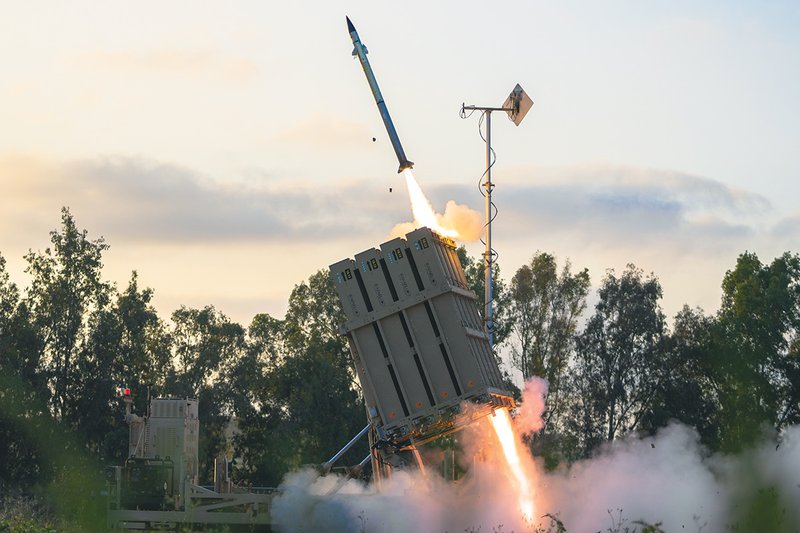
From the opposite perspective, offensive operations “help defence to deal with mass salvos by attacking… the enemy’s stockpiles and reducing the threat that defence needs to deal with in the final stage.”
This dialogue between defensive and offensive operations was clearly demonstrated in the conflict between Israel and Iran.
“One of the reasons that we dealt with that in the way that we did… was the Israeli Air Force capability to create air supremacy in the skies of Iran,” along with the ability of both Israel and the US to ensure combined air defence for Israel’s population, added Brig Gen Shohat.
The power of partnerships
The precise mix of interceptors – including lasers, electronic warfare and ‘hard kill’ systems – will depend on the nation in question, noted Weiss. There is an important industrial element to consider, he said, including the potential for different nations to build partnerships to develop such systems and integrate them effectively.
“It's not only to transfer technology and make the technology sovereign [for the nation in question], but it's also the ability for two, three, and sometimes more nations to build production lines and supply chains that could support increased production of these interceptors and systems,” he said.
Weiss noted that Rafael has taken this approach with such systems as its SPYDER air defence system, which is in use with eight armed forces around the world. “Without partnerships, without technology transfer programmes… the resilience is not going to be created.”
In Israel’s region, “necessity is the mother of invention”, said Brig Gen Shohat, driving the development Iron Dome, the David’s Sling long-range air and missile defence capability, the Arrow family of anti-ballistic missiles, and beyond.
These solutions are not just marketable products for the Israeli defence industry but are combat-proven systems developed to protect the national population. This experience can benefit armed forces and nations that also face a rapidly evolving air defence environment in an increasingly volatile security landscape.
“Israel and the region are a kind of microcosm of the entire world,” Brig Gen Shohat concluded. “What you see here today will be near you tomorrow, so you better get ready.”
Explore Rafael’s full suite of air defence solutions
Discover how Rafael is shaping the future of air and missile defence with proven systems and cutting-edge technologies.


More from The Shephard Defence Podcast
-
![Energy evolution: How laser defence systems are powering the next phase of air defence (podcast)]()
Energy evolution: How laser defence systems are powering the next phase of air defence (podcast)
Laser-based air defence is moving from promise to deployment as global threats evolve. In this special podcast, we explore how high-energy laser systems are reshaping interception strategies.
-
![How satcom is shaping the future of fast, accurate warfare (podcast)]()
How satcom is shaping the future of fast, accurate warfare (podcast)
"Speed is the key advantage and accuracy is the key outcome": Amazon Kuiper Government Solutions’ Rick Freeman talks to Shephard’s Georgia Lewis about how space-as-a-service is transforming defence connectivity and access to satellite capabilities.
-
![Precision on Demand: The New Age of Loitering Weapons (Podcast)]()
Precision on Demand: The New Age of Loitering Weapons (Podcast)
Loitering munitions provide vital capabilities in the disrupted and unpredictable modern battlespace, from real-time ISR to a virtually “on demand” strike capability. Rafael is looking to the future of the technology, empowering systems to operate with increasing autonomy in hostile environments.
-
![Beyond Survivability: How Active Protection Systems Are Empowering Commanders (Podcast)]()
Beyond Survivability: How Active Protection Systems Are Empowering Commanders (Podcast)
As threats diversify and intensify, APS are proving essential not just for vehicle protection but also for enhancing operational freedom, effectiveness and mission success in contested environments.
-
![Combat-proven capabilities: How precision-strike systems are evolving for tomorrow’s battlespace (podcast)]()
Combat-proven capabilities: How precision-strike systems are evolving for tomorrow’s battlespace (podcast)
Combat-tested technology is being reshaped to counter A2/AD threats, reduce reliance on GPS and enable faster, more autonomous targeting in complex environments. In this special podcast, experts explain how the evolving threat landscape is shaping next-generation strike capabilities.
-
![Defending the Fleet: Naval air defence in the drone era (podcast)]()
Defending the Fleet: Naval air defence in the drone era (podcast)
In an era of swarming drones, proliferating missiles and saturation attacks, naval air defence must combine cutting-edge effectiveness with low cost per intercept. Israel’s Rafael is applying its long expertise to help navies adapt to emerging threats, while looking to a future of laser technology – and beyond.