Spain orders 155mm artillery shells in $228 million contract
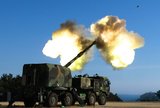
Rheinmetall has had its order book for ammunition further boosted. (Photo: Rheinmetall)
Rheinmetall has become a major source of artillery ammunition across Europe, especially for Ukraine in the face of Russia’s invasion, and the German manufacturer has received orders for billions-of-dollars worth ammunition in recent years.


Spain has placed an order with Rheinmetall for 94,200 155mm rounds under a €208 million (US$228 million) framework agreement.
The artillery rounds will be delivered to the Spanish Army between the end of 2024 and the end of 2025, with a two-year extension option.
The same ammunition has already been in use by the Spanish customer and this marks the second framework agreement.
The artillery ordered is ER02A1 high-explosive (HE) projectiles which have a maximum range of 30km in the boat-tail (BT) variant and almost 40km in the base-bleed (BB) variant.
The latter has a special device at the base of the projectile which heats the air generated by the projectile itself in its trajectory, thus reducing drag and increasing the maximum range.
The latest contracts in the field of 155mm artillery ammunition has underlined Rheinmetall’s position in European ammunition development and production. The company has framework agreements with various NATO countries for the supply of artillery ammunition.
Last month, a ground-breaking ceremony was held for a new plant in Unterlüß, Lower Saxony, which will produce explosives and components for rocket artillery, as well as artillery ammunition in particular.
In the same month, Rheinmetall and a Ukrainian partner company signed a Memorandum of Understanding that will also enable the production of artillery ammunition in Ukraine in the future.

You may also like
More from Land Warfare
-
![US pours another $23 billion into Arsenal of Freedom to ramp up missile production]()
US pours another $23 billion into Arsenal of Freedom to ramp up missile production
The US Department of Defense (DoD) is spending billions of dollars to accelerate missile production to meet demands from the war against Iran and requirements in Ukraine. Manufacture of SM-3 and PAC-3 interceptors is being ramped up, alongside a $22.9 billion commitment to Tomahawk cruise missiles.
-
![Boxer lands another order as contracts and opportunities build momentum]()
Boxer lands another order as contracts and opportunities build momentum
As Germany prepares its €25 billion order under the Arminius framework – the biggest Boxer procurement to date – the platform could become an increasingly powerful contender in European competitions.
-
![Trans-European iMUGS2 uncrewed systems programme set for three-day exercise in 2028]()
Trans-European iMUGS2 uncrewed systems programme set for three-day exercise in 2028
The next stage of the Integrated Modular Unmanned Ground System (iMUGS) programme, dubbed iMUGS2, was launched in November 2025. Three major demonstrations are planned before the end of 2028.
-
![British Army Land Rover replacement plan inches forward]()
British Army Land Rover replacement plan inches forward
The UK Ministry of Defence has proposed a selection date of May 2027 for the Land Rover replacement requirement, with deliveries expected through to 2036. Next month’s DVD exhibition will be a key shop window for bidders.