Romanian Army awaits imminent delivery of first Piranhas
Arrival of first 8x8 wheeled APCs in the coming days fulfils a ‘dire need’ for the Romanian Army, according to the country’s defence minister


The first batch of 36 Piranha V 8x8 wheeled APCs for the Romanian Army are set to be delivered in the coming days, Minister of Defence Nicolae Ionel Ciucă has announced.
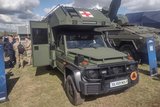
The Piranhas have completed qualification and factory acceptance tests (pictured) at Uzinei Mecanice București. They will enter service with the 26th Infantry Battalion, based in Craiova.
Ciucă admitted on 5 October that the Romanian Army was in ‘dire need of a vehicle to ensure mobility, increased firepower, [and] also increased protection’.
Piranha V and derivatives of the same platform are needed to ensure Romanian Army capabilities match NATO requirements.
An €868 million ($1 billion) agreement to acquire Piranhas V was signed in 2018 between the Romanian Ministry of National Defence and General Dynamics European Land Systems Mowag.
It included procurement of 227 vehicles in six different configurations (IFV; command post; 120mm self-propelled mortar; CBRN; ambulance; and recovery vehicle).
The Piranhas are intended to replace Romania’s fleet of legacy 8x8 licence-produced BTR-60/70/80 APCs and locally built TABC-79 4x4 armoured vehicles.
Related Programmes in Defence Insight
Related Equipment in Defence Insight


More from Land Warfare
-
![British Army's open plan draws diverse offerings for Land Rover replacement]()
British Army's open plan draws diverse offerings for Land Rover replacement
The UK Ministry of Defence has avoided being prescriptive in its search to replace the British Army’s Land Rover, meaning vehicle types being offered range from Land Rover Defender Wolf II and Humvee to the hybrid series Fering Pioneer. What does this mean for the procurement process?
-
![DVD 2026: British Army’s Ajax back in the hands of users as part of a gradual return]()
DVD 2026: British Army’s Ajax back in the hands of users as part of a gradual return
The introduction of Ajax vehicles into British Army service was stopped after operator health issues were reported during an exercise, but manufacturer General Dynamics Land Systems UK believes work over the past 10 months has dealt with the problems.
-
![Europe commits to long-range fires but countries move in different directions]()
Europe commits to long-range fires but countries move in different directions
Sweden, Croatia and France are pursuing different rocket artillery solutions as European armies seek greater reach, survivability and industrial resilience.