Rheinmetall receives US military orders


Rheinmetall has been selected to supply advanced infantry and screening smoke munitions to the US armed forces. The company’s subsidiary, American Rheinmetall Munitions (ARM), has received three five year framework contracts worth a total of $127.8 million for M1110 40 x 46mm day/night training cartridges and 66mm vehicle-launched screening smoke grenades.
The M1110 is a 40 x 46mm low-velocity (LV) cartridge designed to enable infantry forces to conduct live fire training at night. The projectile of the M1110 contains two distinct marking agents which together are able to mark the impact point of the fired projectile with a signature that is visible at day and at night, either with the naked eye or night vision devices, eliminating the need for high explosive rounds in order to observe the impact point.
The 40mm ammunition will be produced at the ARM plant in Camden, Arkansas, with the first deliveries scheduled to take place in 2015.
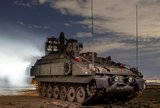
The Rheinmetall 66mm vehicle-launched grenade produces a visible and infrared smokescreen that protects combat vehicles from observation and subsequent targeting by laser illuminators, targeting devices and rangefinders. It uses a proprietary composition of red phosphorus (RP) to provide effective and long-lasting screening effects in both the visual and infrared bands; and to render sensor-guided weapons – particularly anti-tank guided missiles –less effective.
Two framework contracts were placed for the 66mm smoke grenade. For the first award, the US Marine Corps will be ordering additional quantities of the MK 1 MOD 0 version of the 66mm grenade, which is already qualified and in-service with the marines. The second contract was awarded by the Department of the Navy, and will encompass work on a new version of the MK 1 66mm grenade specifically designed to be deployed and function over water, in order to screen small boats operating in ‘brown water’ and littoral environments.


More from Land Warfare
-
![Polaris expands Arctic mobility offering as US military orders grow]()
Polaris expands Arctic mobility offering as US military orders grow
The Military 850 Voyageur 155 Crossover has secured orders from the US Army, Air Force and Marine Corps, addressing demand for agile Arctic mobility with passenger, cargo and towing capacity.
-
![More bidders move onto starting grid for British Army Land Rover replacement programme]()
More bidders move onto starting grid for British Army Land Rover replacement programme
The Light Mobility Vehicle segment of the UK’s Land Mobility Programme for the British Army may actually be about to make progress, or at least likely bidders seem to think so. Shephard spoke with several contenders who revealed their views on how the army should replace the ageing fleet.
-
![Northrop Grumman pushing ahead with smaller Integrated Battle Command System]()
Northrop Grumman pushing ahead with smaller Integrated Battle Command System
Northrop Grumman’s Integrated Battle Command System is in service with Polish forces and is being introduced to US forces, with further development underway on the original platform as well as a smaller, more mobile system.
-
![UK’s ground-based air defence effort remains in assessment phase after third industry day]()
UK’s ground-based air defence effort remains in assessment phase after third industry day
The UK’s plan to introduce a new air defence capability into the British Army will cover short and medium-range defence as well as counter-uncrewed aerial system systems. Timelines are not yet laid out but industry is making plans.