QinetiQ to evaluate APS for Dstl


QinetiQ has been awarded a £7.6 million contract by the UK Defence Science and Technology Laboratory (DSTL) to evaluate an active protection system (APS) for armoured vehicles under Project Medusa, it was announced on 5 July.
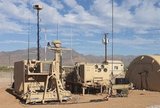
QinetiQ will work with several sub-contractors, including Airbus Defence and Space, which has been contracted to supply a number of systems based on the Multi-function Self-protection System (MUSS) for evaluation. The technical assessments will quantify the system’s performance against a range of weapon systems.
For these assessments, BAE Systems will integrate MUSS on a Challenger 2 main battle tank to demonstrate potential future capability. Textron and Frazer-Nash are also key contributors for the Medusa team.
The Medusa Technical Assessment Programme is part of the DSTL’s ongoing research into APS, alongside efforts to develop open architecture for future modular capability. The APS will sense threats and provide a ‘soft’ or ‘hard’ response to defeat them before they strike the vehicle.
The soft response will be based on obscuring or jamming the guidance mechanism of the threat, and the hard response will involve physical interception of the threat.
Andy Brownlow, head of business development, land systems at QinetiQ, said: ‘Our focus on Medusa is to assess capability, provide independent guidance and impart QinetiQ’s knowledge and experience across platform survivability, related sensor and effector technologies as well as the vehicle architecture domains to ensure we successfully deliver the potential game-changing improvements in capability for the armed forces.’
Brig Ian Gibb, head of combat capability at army headquarters, Andover, said: ‘The development of an effective APS would provide a hugely significant step change in the survivability of our platforms, particularly as we are reaching the technological limits of what passive armour can achieve.
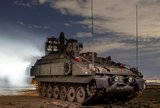
‘Initially, this capability is likely to have utility across all of our major battle-winning equipment programmes - Ajax, Warrior, Challenger 2 and the Mechanised Infantry Vehicle. But elements of APS should have applications across other platforms and systems too. We look forward to continuing to work alongside DSTL in this key project.’
Related Equipment in Defence Insight



More from Land Warfare
-
![Europe commits to long-range fires but countries move in different directions]()
Europe commits to long-range fires but countries move in different directions
Sweden, Croatia and France are pursuing different rocket artillery solutions as European armies seek greater reach, survivability and industrial resilience.
-
![Polaris expands Arctic mobility offering as US military orders grow]()
Polaris expands Arctic mobility offering as US military orders grow
The Military 850 Voyageur 155 Crossover has secured orders from the US Army, Air Force and Marine Corps, addressing demand for agile Arctic mobility with passenger, cargo and towing capacity.
-
![Northrop Grumman pushing ahead with smaller Integrated Battle Command System]()
Northrop Grumman pushing ahead with smaller Integrated Battle Command System
Northrop Grumman’s Integrated Battle Command System is in service with Polish forces and is being introduced to US forces, with further development underway on the original platform as well as a smaller, more mobile system.
-
![UK’s ground-based air defence effort remains in assessment phase after third industry day]()
UK’s ground-based air defence effort remains in assessment phase after third industry day
The UK’s plan to introduce a new air defence capability into the British Army will cover short and medium-range defence as well as counter-uncrewed aerial system systems. Timelines are not yet laid out but industry is making plans.