Northrop Grumman’s G/ATOR passes IOT&E


Northrop Grumman, in partnership with the US Marine Corps, has completed a successful initial operational test and evaluation (IOT&E) for the AN/TPS-80 Ground/Air Task-Oriented Radar (G/ATOR) Blocks 1 and 2, the company announced on 13 May.
The milestone demonstrates the suitability and viability of the system, and indicates that the marine corps is ready to operate and field G/ATOR Blocks 1 and 2 in their current configuration.
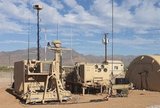
The AN/TPS-80 G/ATOR is an advanced, multi-mission active electronically scanned array radar that provides comprehensive real time, 360° situational awareness. The radar system is designed to help soldiers detect and take action against complex, modern threats.
To date, eight production systems have been delivered to the marine corps. In early 2017, Northrop Grumman delivered six low rate initial production systems, and the first Gallium Nitride systems were delivered in July 2018.
Related Equipment in Defence Insight


More from Land Warfare
-
![Europe commits to long-range fires but countries move in different directions]()
Europe commits to long-range fires but countries move in different directions
Sweden, Croatia and France are pursuing different rocket artillery solutions as European armies seek greater reach, survivability and industrial resilience.
-
![MAAF to test Britain’s shift from armour to distributed lethality in Estonia]()
MAAF to test Britain’s shift from armour to distributed lethality in Estonia
The bilateral agreement between the UK and Estonia comes as both countries explore how dispersed troops, drones, digital targeting, anti-tank weapons and increasingly long-range fires can complement the combat mass traditionally provided by heavy armour.
-
![Polaris expands Arctic mobility offering as US military orders grow]()
Polaris expands Arctic mobility offering as US military orders grow
The Military 850 Voyageur 155 Crossover has secured orders from the US Army, Air Force and Marine Corps, addressing demand for agile Arctic mobility with passenger, cargo and towing capacity.
-
![More bidders move onto starting grid for British Army Land Rover replacement programme]()
More bidders move onto starting grid for British Army Land Rover replacement programme
The Light Mobility Vehicle segment of the UK’s Land Mobility Programme for the British Army may actually be about to make progress, or at least likely bidders seem to think so. Shephard spoke with several contenders who revealed their views on how the army should replace the ageing fleet.
-
![UK’s ground-based air defence effort remains in assessment phase after third industry day]()
UK’s ground-based air defence effort remains in assessment phase after third industry day
The UK’s plan to introduce a new air defence capability into the British Army will cover short and medium-range defence as well as counter-uncrewed aerial system systems. Timelines are not yet laid out but industry is making plans.