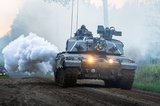
Northrop demos APS for US Army


Northrop Grumman demonstrated advanced vehicle active protection system (APS) technologies against anti-tank guided munitions (ATGM) during a US Army sponsored exercise in Huntsville, Alabama.
The exercise, sponsored by the US Army Tank Automotive Research Development Engineering Center, was carried out to demonstrate and test soft-kill capabilities against real world threats.
During the exercise, Northrop Grumman successfully generated threat warning of inbound ATGMs using its passive infrared cueing sensors system, whch then provided a cue for the soft kill countermeasure system (SKCM).
The SKCM system, known as the Multifunction Electro-Optical System, successfully countered the ATGM and defeated it in real-time.
Mike Meaney, VP, advanced missions, Northrop Grumman, said: ‘This solution is an example of leveraging significant investment in aircraft protection to rapidly provide similar capabilities to ground vehicles. We look forward to working with the army to deploy an affordable end-to-end vehicle APS system that can defeat a variety of anti-tank guided munitions.’

More from Land Warfare
-
![DVD 2026: British Army’s Ajax back in the hands of users as part of a gradual return]()
DVD 2026: British Army’s Ajax back in the hands of users as part of a gradual return
The introduction of Ajax vehicles into British Army service was stopped after operator health issues were reported during an exercise, but manufacturer General Dynamics Land Systems UK believes work over the past 10 months has dealt with the problems.
-
![Europe commits to long-range fires but countries move in different directions]()
Europe commits to long-range fires but countries move in different directions
Sweden, Croatia and France are pursuing different rocket artillery solutions as European armies seek greater reach, survivability and industrial resilience.
-
![MAAF to test Britain’s shift from armour to distributed lethality in Estonia]()
MAAF to test Britain’s shift from armour to distributed lethality in Estonia
The bilateral agreement between the UK and Estonia comes as both countries explore how dispersed troops, drones, digital targeting, anti-tank weapons and increasingly long-range fires can complement the combat mass traditionally provided by heavy armour.