Lockheed Martin announces US Army THAAD contract


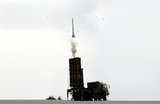
Lockheed Martin has announced that it has been awarded a contract from the Missile Defence Agency (MDA) to produce Terminal High Altitude Area Defence (THAAD) Weapon System launchers and fire control and communications equipment for the US Army. The company announced the $150 million contract 15 August 2012.
According to the company, the contract includes 12 launchers, two fire control and communications units, and associated support equipment. In total this contract will provide six launchers for THAAD battery 5 and an additional three launchers each to batteries 1 and 2, and will bring all batteries to the standard six launcher configuration.
The production contract for the first two batteries was awarded to Lockheed Martin in late 2006, and contracts for batteries 3 and 4 were awarded in 2011. Delivery of equipment for Battery 5 will be completed by 2015.
The THAAD programme has successfully completed 12 flight tests since 2005, with nine-for-nine intercepts. THAAD is designed to intercept in both the endo- and exo-atmospheres to provide versatile capability to the warfighter. It is a key element of the US Ballistic Missile Defence System (BMDS) and its mission to defend the US, its deployed forces and allies against short and medium range ballistic missiles in the terminal phase of flight.


More from Land Warfare
-
![Thales Storm 2 counter-drone system being evaluated by potential customers]()
Thales Storm 2 counter-drone system being evaluated by potential customers
The attack drone threat from first-person view uncrewed aerial systems has been highlighted by recent conflicts and Thales has adapted its Storm 2 counter-improvised explosive device jammer to provide protection.
-
![Rolls-Royce to lead powertrain development for MGCS in important step for the programme]()
Rolls-Royce to lead powertrain development for MGCS in important step for the programme
The move signals significant progress for the delayed Franco-German Main Ground Combat System programme with first powerpack prototypes set to be tested before the end of the decade.
-
![Australia’s DroneShield looks to Europe in a drive to massively increase production]()
Australia’s DroneShield looks to Europe in a drive to massively increase production
DroneShield has experienced significant growth in a short period of time, more than doubling its personnel to 500 people in the space of 18 months on the back of both military and civil demand.