


Companies downselected for British Army vehicle programme
It is believed that three companies did not make the downselect but a dark horse in Spain’s Iturri is believed to have got through.


Rostec company Kalashnikov has unveiled the first prototype of its VSV-338 high-precision modular rifle and the prototype of its SVK semi-automatic sniper rifle.
The VSV-338 long-range sniper rifle can be used with the .338 Lapua Magnum cartridge, in any weather conditions at a range of up to 1,500m. The forend of the rifle features the Key-MOD system to attach accessories such as bipods, sling loops and detachable Picatinny rails to support mechanical and optical sights and night vision device attachments.
The rifle has a side-folding buttstock with an adjustable pull and cheek riser, and a height-adjustable rear support. The VSV-338 is assembled on an aluminium alloy base plate allowing the shooter to change barrels quickly. The barrel uses a sliding-breech rotary bolt as a locking mechanism; it has an adjustable two-stage trigger and ambidextrous safety locks for the bolt, trigger and sear.
The SVK is a compact semi-automatic sniper rifle designed in two modifications. One uses the NATO standard 7.62x51 cartridges and the other uses Russian 7.62x54R cartridges. The rifle is fed from detachable box magazines with a standard (10 cartridges) or high (15 or 20 cartridges) capacity.
The SVK has an inverted U-shaped steel receiver that hosts the suspended bolt group. It uses a rotary bolt locking and manually adjustable gas regulator and has a Picatinny rail to attach sighting systems.
The SVK is currently undergoing manufacturer trials.


It is believed that three companies did not make the downselect but a dark horse in Spain’s Iturri is believed to have got through.
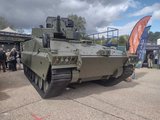
Air defence and counter-drone weapons continue to be developed, tested and demonstrated in anticipation of growing demand, with most solutions designed to be platform-agnostic and readily integrated onto suitable platforms.
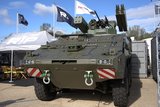
The US Army began its search for a 155mm tracked mobile tactical cannon in an effort that Shephard forecasts could be worth billions of dollars. Meanwhile, the UK DVD exhibition saw companies showcase their offerings for the British Army’s mobility and air defence requirements.
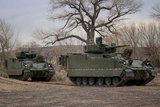
The development demonstrates how the platform could provide additional firepower and growth potential while the US Army progresses its long-term replacement for the Bradley.
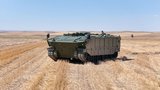
FNSS and PT Pindad are progressing the Indonesian tracked armoured personnel carrier programme as local production gets under way.
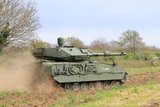
Firing trials of the Tulpar and Leonardo Hitfact Mk II combination follow an integration programme covering mechanical, electrical, electronic and software interfaces.

Connect with us on socials


