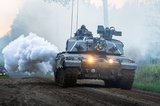
Germany orders 120mm MBT practice ammo


Rheinmetall has received a contract worth $28.6 million from the German Bundeswehr to supply new 120mm DM98 practice ammunition for main battle tanks, the company announced on 3 November.
This is the German Army’s first order of the new full-calibre 120mm practice ammunition.
Rheinmetall willl manufacture and deliver 10,000 rounds of DM98 ammunition, which will be delivered to Bundeswehr before the end of 2017. The company expects to receive an order for a further 3,200 cartridges at the beginning of 2018, with delivery taking place in the first quarter of the year.
Rheinmetall Waffe Munition developed the 120mm full-calibre round as a successor to the earlier DM18. Characteristics of the new cartridge include a geometry and length comparable to the DM18 and above average accuracy even at ranges exceeding 2,000m. It also features a tracer function that provides steady visibility in all light conditions.
The new round, initially known as the RH88, was qualified in 2015 for all variants of Leopard 2 main armament, with Denmark serving as the pilot customer. In 2016, it was successfully qualified with a second packaging system by the Bundeswehr and was introduced as the DM98.
Related Equipment in Defence Insight



More from Land Warfare
-
![Europe commits to long-range fires but countries move in different directions]()
Europe commits to long-range fires but countries move in different directions
Sweden, Croatia and France are pursuing different rocket artillery solutions as European armies seek greater reach, survivability and industrial resilience.
-
![MAAF to test Britain’s shift from armour to distributed lethality in Estonia]()
MAAF to test Britain’s shift from armour to distributed lethality in Estonia
The bilateral agreement between the UK and Estonia comes as both countries explore how dispersed troops, drones, digital targeting, anti-tank weapons and increasingly long-range fires can complement the combat mass traditionally provided by heavy armour.
-
![Polaris expands Arctic mobility offering as US military orders grow]()
Polaris expands Arctic mobility offering as US military orders grow
The Military 850 Voyageur 155 Crossover has secured orders from the US Army, Air Force and Marine Corps, addressing demand for agile Arctic mobility with passenger, cargo and towing capacity.