FN Herstal demonstrates new C-UAS solutions
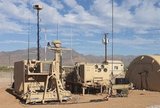
FN Herstal perimeter defence system integrating deFNder remote weapon stations. (Photo FN Herstal)
The deFNder Family of Remote Weapon Stations from FN Herstal was tested for countering UAVs during the NATO Non-Lethal Technology Exercise (NNTEX-C) in Sardinia, Italy.


FN Herstal announced on 29 March that its deFNder family of remote weapon stations (RWSs) was tested for countering UAVs during the NATO Non-Lethal Technology Exercise (NNTEX-C) in Sardinia, Italy.
The trials on 4-24 March involved the deFNder Light and the deFNder Medium.
FN Herstal developed a container-based perimeter defence solution incorporating a range of sensors and combining both soft and hard effectors. The overall system was operated by two operators protected inside the container.
The sensors enable early detection and provide operators and commanders with the localisation of the detected targets on a 2D situational awareness map, which enhances the mission-critical decision-making process and allows a quick response.
It also features a smart and scalable signal jammer that can be used as a first response against the UAV to disable the link between the aircraft and its operator before resorting to live-firing.
The deFNder Light RWS can be fitted with the FN Minimi 5.56mm, FN Minimi 7.62mm or FN MAG 7.62mm machine gun.
In the case of the deFNder Medium, it can feature the FN MAG 7.62mm, .50 calibre weapons such as the FN M2HB-QCB and FN M3R, or a 40mm Automatic Grenade Launcher with airburst capacity.
The NNTEX-C exercise was dedicated to the evaluation of efficiency, collateral damage and ergonomics of current technologies against so-called “low, slow and small” targets.
Related Equipment in Defence Insight




More from Land Warfare
-
![DVD 2026: British Army’s Ajax back in the hands of users as part of a gradual return]()
DVD 2026: British Army’s Ajax back in the hands of users as part of a gradual return
The introduction of Ajax vehicles into British Army service was stopped after operator health issues were reported during an exercise, but manufacturer General Dynamics Land Systems UK believes work over the past 10 months has dealt with the problems.
-
![Europe commits to long-range fires but countries move in different directions]()
Europe commits to long-range fires but countries move in different directions
Sweden, Croatia and France are pursuing different rocket artillery solutions as European armies seek greater reach, survivability and industrial resilience.
-
![MAAF to test Britain’s shift from armour to distributed lethality in Estonia]()
MAAF to test Britain’s shift from armour to distributed lethality in Estonia
The bilateral agreement between the UK and Estonia comes as both countries explore how dispersed troops, drones, digital targeting, anti-tank weapons and increasingly long-range fires can complement the combat mass traditionally provided by heavy armour.
-
![Polaris expands Arctic mobility offering as US military orders grow]()
Polaris expands Arctic mobility offering as US military orders grow
The Military 850 Voyageur 155 Crossover has secured orders from the US Army, Air Force and Marine Corps, addressing demand for agile Arctic mobility with passenger, cargo and towing capacity.
-
![More bidders move onto starting grid for British Army Land Rover replacement programme]()
More bidders move onto starting grid for British Army Land Rover replacement programme
The Light Mobility Vehicle segment of the UK’s Land Mobility Programme for the British Army may actually be about to make progress, or at least likely bidders seem to think so. Shephard spoke with several contenders who revealed their views on how the army should replace the ageing fleet.
-
![Northrop Grumman pushing ahead with smaller Integrated Battle Command System]()
Northrop Grumman pushing ahead with smaller Integrated Battle Command System
Northrop Grumman’s Integrated Battle Command System is in service with Polish forces and is being introduced to US forces, with further development underway on the original platform as well as a smaller, more mobile system.