Dozor-B production to start soon, says Ukroboronprom


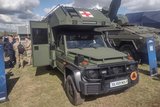
The Dozor-B tactical combat wheeled vehicle is set to begin serial production once qualification tests are completed by the Ukrainian Army.
Designed by the Kharkiv Design Bureau for Mechanical Engineering (HCBM) and produced by the Lviv Armoured Plant (both subsidiaries of Ukroboronprom), Dozor-B is an all-wheel drive 4x4 armoured vehicle.
It is designed as a multi-purpose protected vehicle for transporting personnel, weapons and military equipment weighing up to 2t.
Ukroboronprom envisages production of APC, ambulance, command and staff, reconnaissance and special forces variants.
Adoption of Dozor-B by Ukraine ‘also increases the export potential of this armored vehicle’, claimed Aivaras Abromavicius, general director of Ukroboronprom.
The first batch of ten Dozor-B vehicles was produced in June 2016 for evaluation by the Armed Forces of Ukraine, including operations against pro-Russian separatist rebels in Donbass. Final changes to the design were made earlier this year.
As part of our promise to deliver comprehensive coverage to our Defence Insight and Premium News subscribers, our curated defence news content provides the latest industry updates, contract awards and programme milestones.
Related Programmes in Defence Insight
Related Equipment in Defence Insight

More from Land Warfare
-
![DVD 2026: British Army’s Ajax back in the hands of users as part of a gradual return]()
DVD 2026: British Army’s Ajax back in the hands of users as part of a gradual return
The introduction of Ajax vehicles into British Army service was stopped after operator health issues were reported during an exercise, but manufacturer General Dynamics Land Systems UK believes work over the past 10 months has dealt with the problems.
-
![Europe commits to long-range fires but countries move in different directions]()
Europe commits to long-range fires but countries move in different directions
Sweden, Croatia and France are pursuing different rocket artillery solutions as European armies seek greater reach, survivability and industrial resilience.
-
![MAAF to test Britain’s shift from armour to distributed lethality in Estonia]()
MAAF to test Britain’s shift from armour to distributed lethality in Estonia
The bilateral agreement between the UK and Estonia comes as both countries explore how dispersed troops, drones, digital targeting, anti-tank weapons and increasingly long-range fires can complement the combat mass traditionally provided by heavy armour.