Bumerang takes a small step towards autonomy
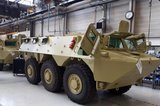
K-17 Bumerang IFV, pictured at the Army 2020 event near Moscow. (Photo: Alex Tarasoff)
Manufacturer VPK claims to have made progress on developing a remotely controlled version of the Bumerang 8x8 — but it hard to see the Russian Ground Forces adopting it soon.


Russian manufacturer VPK has tested a remotely controlled Bumerang 8x8 wheeled armoured vehicle.
The prototype can move forward and backwards, rotate its turret and move the gun up and down, said VPK general director Alexander Krasovitsky in a recent interview with Russian TV station RBK.
The operator can see basic data on fuel capacity and oil temperature. Krasovitsky even mentioned that the vehicle is controllable from a mobile phone, but obviously the solution is temporary.
In February 2021, he hinted at teleoperation for Bumerang: ‘If needed, the Bumerang could be controlled remotely; in other words, the information-management system of the
Our news & analysis is now part of Defence Insight®
A Basic-level or higher Defence Insight subscription is now required to view this content.


More from Land Warfare
-
![AUSA 2026: companies adapt munitions and missiles for greater effect at lower costs]()
AUSA 2026: companies adapt munitions and missiles for greater effect at lower costs
Rather than developing entirely new weapons, defence companies are looking to build on existing weapons and systems to deliver greater capability, control costs and accelerate fielding.
-
![AUSA 2026: CUAS market expands as suppliers target new threats and operational requirements]()
AUSA 2026: CUAS market expands as suppliers target new threats and operational requirements
New developments from MARSS, MyDefence, Mountain Horse Solutions and Rafael suggest that future counter-drone protection will increasingly depend on combining advanced detection, rapid interception and integrated defensive networks.
-
![US Army seeks CAML-Lite autonomous launcher prototypes for 2027 live-fire trials]()
US Army seeks CAML-Lite autonomous launcher prototypes for 2027 live-fire trials
The optionally crewed, C-130-transportable platforms would combine modular offensive and defensive fires with autonomous resupply, with demonstrations planned for Talisman Sabre 2027.