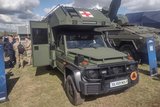
BAE Systems, Patria team for Australian CRV


BAE Systems and Patria have announced plans to jointly pursue Australia’s Combat Reconnaissance Vehicle (CRV) programme. Under a teaming agreement announced on 22 September, BAE Systems will act as prime contractor with the support of Patria.
The Australian government is seeking CRVs from industry as part of its Land 400 programme. This programme seeks to address the emerging mounted close combat capability gap that exists between the current in service vehicles and increasingly capable weapons that could be used against Australian forces. The CRV is being procured under Land 400 Phase 2.
BAE Systems and Patria plan to offer a Patria 8x8 Armoured Modular Vehicle (AMV) solution for the programme. The vehicle will be developed to meet requirements, which are heavily focused on networked capabilities for optimised operational effects; improved firepower, protection, and mobility.
Graeme Bent, acting director – land & integrated systems, BAE Systems Australia, said: ‘We make a strong team. Patria has a proven track record of technology transfer to user nations, and BAE Systems has a long and proud history of building and supporting both tracked and wheeled military vehicles, here and overseas. Continued local support will enable the ADF to draw upon an established manufacturing base and our global network.’
Markku Bollmann, senior vice president, land business unit, Patria, added: ‘Patria AMV combines high payload capacity and excellent mobility with the latest technology. The versatility of the modular design enables it to be tailored and continually developed to meet the needs of modern defence forces around the world.
‘Patria AMV is a highly capable vehicle with strong sales track-record and in use by seven different nations in wide range of environments. The vehicle is combat-proven in the real mission environment.’

More from Land Warfare
-
![British Army's open plan draws diverse offerings for Land Rover replacement]()
British Army's open plan draws diverse offerings for Land Rover replacement
The UK Ministry of Defence has avoided being prescriptive in its search to replace the British Army’s Land Rover, meaning vehicle types being offered range from Land Rover Defender Wolf II and Humvee to the hybrid series Fering Pioneer. What does this mean for the procurement process?
-
![DVD 2026: British Army’s Ajax back in the hands of users as part of a gradual return]()
DVD 2026: British Army’s Ajax back in the hands of users as part of a gradual return
The introduction of Ajax vehicles into British Army service was stopped after operator health issues were reported during an exercise, but manufacturer General Dynamics Land Systems UK believes work over the past 10 months has dealt with the problems.
-
![Europe commits to long-range fires but countries move in different directions]()
Europe commits to long-range fires but countries move in different directions
Sweden, Croatia and France are pursuing different rocket artillery solutions as European armies seek greater reach, survivability and industrial resilience.