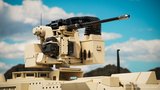
BAE Systems M777 Howitzer programme exceeds £1bn sales
BAE Systems has received an order for 93 additional M777 howitzers, taking the order book to 955 systems and taking sales for the programme to over £1bn.
The US is buying 58 guns for the US Army and US Marine Corps while Australia is acquiring 35 through the US Foreign Military Sales (FMS) program. The order makes Australia the third customer for the M777 system after the US and Canada.
Mike Smith, managing director for BAE Systems’ European Weapons business, commented on the gun acquisition contract: “The purchase of additional howitzers is further endorsement of M777 as the most effective howitzer system of its kind. Its proven combat effectiveness means we expect more orders through 2011 as we continue to promote the system globally.
“The US government is currently discussing the provision of 145 systems to India as well as several other countries. In parallel, BAE Systems is responding to requests for information from a large number of countries wishing to expand their indirect fire capability.”
BAE System’ facility at Hattiesburg, Mississippi, is responsible for final integration and test of the weapon system. The prime contract management of the M777 program and manufacture and assembly of the complex titanium structures and associated recoil components are undertaken at Barrow-in-Furness in the United Kingdom.
The M777 continues to provide artillery support to coalition forces in Afghanistan where its performance exceeds expectations. The gun can fire the “smart” Excalibur round, co-developed by BAE Systems, up to 40 km (25m) accurately enough to target a specific room within a building, reducing the chance of innocent casualties and allowing supporting fire to be brought down much closer to friendly troops.
BAE Systems has also recently agreed to provide an $18m (£12m) support package for M777 directly with Canada, which is procuring 37 guns via FMS. The contract covers the supply of spares and engineering support.
Weighing in at less than 4200kg, the revolutionary M777 is the world’s first artillery weapon to make widespread use of titanium and aluminium alloys, resulting in a howitzer which is half the weight of conventional 155mm systems. This allows it to be deployed by medium-lift helicopter quickly and beyond the reach of roadside bombs to otherwise inaccessible areas, extending its reach over the theatre of operations.
The M777 effort is managed by the US Army/Marines Light Weight 155mm Joint Program Office at Picatinny Arsenal, New Jersey.
Source: BAE Systems



More from Land Warfare
-
![AUSA 2026 preview: Uncrewed systems and platforms to defend against them set to feature]()
AUSA 2026 preview: Uncrewed systems and platforms to defend against them set to feature
The Association of the US Army’s flagship conference and exhibition takes place in Washington, DC from 12 to 14 October. Shephard takes a look at what might be in store at the 2026 show, with uncrewed and counter-uncrewed systems and platforms under the spotlight.
-
![“A survivable architecture”: why resilient communications are no longer a luxury]()
“A survivable architecture”: why resilient communications are no longer a luxury
In Conversation… Military communications must adapt to a rapidly evolving battlespace, characterised by decentralised forces and an increasingly contested electromagnetic spectrum. To survive and thrive, it is vital to prioritise resilient systems and networks, Faisal Munir, President – Mission-Critical Communications at L3Harris Technologies, told Shephard’s Gerrard Cowan.
-
![New uses for proven weapons: adapting the Chain Gun for CUAS]()
New uses for proven weapons: adapting the Chain Gun for CUAS
Northrop Grumman’s M230LF Chain Gun is finding a growing role in countering uncrewed aerial systems, with the 30mm weapon already deployed to Ukraine and adopted by US forces.
-
![Companies downselected for British Army vehicle programme]()
Companies downselected for British Army vehicle programme
It is believed that three companies did not make the downselect but a dark horse in Spain’s Iturri is believed to have got through.