Australia requests JCREW equipment
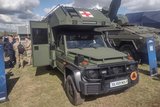
Australia has requested Joint Counter Radio-Controlled Improvised Explosive Device Electronic Warfare (JCREW) systems from the US government, the Defense Security Cooperation Agency announced on 20 November.
Under a foreign military sale worth an estimated $245 million Australia wants up to 850 JCREW Increment 1 Block 1 (I1B1) systems and related equipment. Of these, 533 will be vehicle mounted and 317 dismounted.
Also included are spare and repair parts; support and test equipment; technical exchanges, publications and technical documentation; support equipment; and other related elements of logistics support.
The equipment will provide Australia increased force protection from radio-controlled improvised explosive device threats for its defence forces and vehicles.
If the sale goes ahead the prime contractor will be Northrop Grumman.





More from Land Warfare
-
![British Army's open plan draws diverse offerings for Land Rover replacement]()
British Army's open plan draws diverse offerings for Land Rover replacement
The UK Ministry of Defence has avoided being prescriptive in its search to replace the British Army’s Land Rover, meaning vehicle types being offered range from Land Rover Defender Wolf II and Humvee to the hybrid series Fering Pioneer. What does this mean for the procurement process?
-
![DVD 2026: British Army’s Ajax back in the hands of users as part of a gradual return]()
DVD 2026: British Army’s Ajax back in the hands of users as part of a gradual return
The introduction of Ajax vehicles into British Army service was stopped after operator health issues were reported during an exercise, but manufacturer General Dynamics Land Systems UK believes work over the past 10 months has dealt with the problems.
-
![Europe commits to long-range fires but countries move in different directions]()
Europe commits to long-range fires but countries move in different directions
Sweden, Croatia and France are pursuing different rocket artillery solutions as European armies seek greater reach, survivability and industrial resilience.
-
![MAAF to test Britain’s shift from armour to distributed lethality in Estonia]()
MAAF to test Britain’s shift from armour to distributed lethality in Estonia
The bilateral agreement between the UK and Estonia comes as both countries explore how dispersed troops, drones, digital targeting, anti-tank weapons and increasingly long-range fires can complement the combat mass traditionally provided by heavy armour.
-
![Polaris expands Arctic mobility offering as US military orders grow]()
Polaris expands Arctic mobility offering as US military orders grow
The Military 850 Voyageur 155 Crossover has secured orders from the US Army, Air Force and Marine Corps, addressing demand for agile Arctic mobility with passenger, cargo and towing capacity.