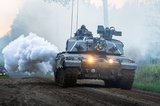
Germany orders more Boxer vehicles


Rheinmetall and Krauss-Maffei Wegmann (KMW) joint venture Artec will supply Germany with additional Boxer armoured fighting vehicles under a $516 million order announced on 18 December.
The contract, which was awarded by Occar on behalf of the German defence procurement agency, calls for Artec to deliver 131 Boxer vehicles in armoured personnel carrier (APC) configuration. Delivery will take place in 2017-2020.
Germany made its initial Boxer order in 2006 for 272 vehicles. These vehicles are configured for a range of roles, including command and control, medevac and driver training vehicles as well as APCs capable of transporting a complete infantry section/squad. Deliveries under this order are ongoing and are set to complete in March 2016.
The Boxer is a highly protected 8x8 tactical vehicle. Its composite add-on armour is designed to deliver protection against landmines, improvised explosive devices and ballistic fire. The highly mobile vehicle is powered by a 530kW (720HP) MTU turbo diesel engine. Weighing in at up to 36.5 tonnes with a full combat load, the vehicle is capable of attaining a top speed of 103km/h.
In the section/squad APC configuration, the Boxer serves as a ‘mother ship’ for up to ten troops. It is equipped with a remotely operated FLW 200 light weapon station featuring a 40mm automatic grenade launcher or 12.7mm heavy machine gun.
Related Equipment in Defence Insight


More from Land Warfare
-
![Europe commits to long-range fires but countries move in different directions]()
Europe commits to long-range fires but countries move in different directions
Sweden, Croatia and France are pursuing different rocket artillery solutions as European armies seek greater reach, survivability and industrial resilience.
-
![MAAF to test Britain’s shift from armour to distributed lethality in Estonia]()
MAAF to test Britain’s shift from armour to distributed lethality in Estonia
The bilateral agreement between the UK and Estonia comes as both countries explore how dispersed troops, drones, digital targeting, anti-tank weapons and increasingly long-range fires can complement the combat mass traditionally provided by heavy armour.
-
![Polaris expands Arctic mobility offering as US military orders grow]()
Polaris expands Arctic mobility offering as US military orders grow
The Military 850 Voyageur 155 Crossover has secured orders from the US Army, Air Force and Marine Corps, addressing demand for agile Arctic mobility with passenger, cargo and towing capacity.