Advanced C-IED sensors at the NATO Kandahar Airfield
The NATO Consultation, Command and Control Agency (NC3A) successfully implemented advanced Counter Improvised-Explosive Devices (C-IED) infrastructure on a new Entry Control Point at NATO’s Kandahar air base, which will significantly boost the Alliance’s ability to supply the base. The installation of the devices was accomplished well ahead of the opening of the control point.
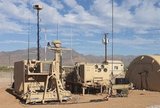
The advanced Counter Improvised-Explosive Devices (C-IED) systems allow for the detection of explosives, weapons and radioactive materials in a stream of vehicles and people crossing one of the busiest Entry Control Points in Afghanistan. The facility employs state of the art technology, including:
• vehicle scanners for Vehicle Borne IED, weapons and radioactive material detection;
• pedestrian screening sensors for potential Suicide Bomber and radioactive material detection;
• arch metal detector for additional pedestrian screening.
The NC3A-delivered system significantly boosts safety at the entry point without compromising the need for rapid and seamless logistics that Kandahar relies on. The vehicle screening sensors will operate in parallel and will deliver the highest throughput of all ISAF Entry Control Points, with hundreds of vehicles screened on a daily basis.
“The quick implementation of the system would not be possible without the joint effort of experts from the NC3A project team, our NC3A Field Office in Kandahar, the Acquisition Support Group, and our contracting partners support. As a result, all the systems are now operational and await the control point opening.” - said Dr. Franco Fiore, Principal Scientist at the NATO C3 Agency in charge of the project execution.
The C-IED system is a part of the broad catalogue of expertise and solutions that NC3A - responsible for delivering advanced technology in support of Alliance missions - offers to NATO and its Nations.
As part of this effort in supporting NATO nations in procuring and fielding C-IED C4ISR capability, on Nov 16th, NC3A will host in Brussels the 1st C-IED Workshop on Multinational Cooperation.
Source: NATO C3 Agency



You may also like

More from Land Warfare
-
![DVD 2026: British Army’s Ajax back in the hands of users as part of a gradual return]()
DVD 2026: British Army’s Ajax back in the hands of users as part of a gradual return
The introduction of Ajax vehicles into British Army service was stopped after operator health issues were reported during an exercise, but manufacturer General Dynamics Land Systems UK believes work over the past 10 months has dealt with the problems.
-
![Europe commits to long-range fires but countries move in different directions]()
Europe commits to long-range fires but countries move in different directions
Sweden, Croatia and France are pursuing different rocket artillery solutions as European armies seek greater reach, survivability and industrial resilience.
-
![MAAF to test Britain’s shift from armour to distributed lethality in Estonia]()
MAAF to test Britain’s shift from armour to distributed lethality in Estonia
The bilateral agreement between the UK and Estonia comes as both countries explore how dispersed troops, drones, digital targeting, anti-tank weapons and increasingly long-range fires can complement the combat mass traditionally provided by heavy armour.
-
![Polaris expands Arctic mobility offering as US military orders grow]()
Polaris expands Arctic mobility offering as US military orders grow
The Military 850 Voyageur 155 Crossover has secured orders from the US Army, Air Force and Marine Corps, addressing demand for agile Arctic mobility with passenger, cargo and towing capacity.
-
![More bidders move onto starting grid for British Army Land Rover replacement programme]()
More bidders move onto starting grid for British Army Land Rover replacement programme
The Light Mobility Vehicle segment of the UK’s Land Mobility Programme for the British Army may actually be about to make progress, or at least likely bidders seem to think so. Shephard spoke with several contenders who revealed their views on how the army should replace the ageing fleet.
-
![Northrop Grumman pushing ahead with smaller Integrated Battle Command System]()
Northrop Grumman pushing ahead with smaller Integrated Battle Command System
Northrop Grumman’s Integrated Battle Command System is in service with Polish forces and is being introduced to US forces, with further development underway on the original platform as well as a smaller, more mobile system.