US Navy to commission LCS 13
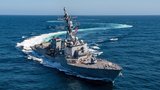
The US Navy is set to commission its new Littoral Combat Ship (LCS) 13, the future USS Wichita, at Naval Station Mayport in Jacksonville, Florida, on 12 January.
Wichita is a Freedom-class LCS designed to support operation in near-shore environments as well as in the open-ocean. The vessel can be deployed to support missions in the areas of mine countermeasures, anti-submarine warfare and surface warfare.
The LCS class consists of two variants, the Freedom-variant and the Independence-variant. The Freedom variant team is led by Lockheed Martin and the Independence-variant team is led by Austal USA.



You may also like
More from Naval Warfare
-
![US Navy SPY-6 approaches FRP with Raytheon already having “a hot production line”]()
US Navy SPY-6 approaches FRP with Raytheon already having “a hot production line”
Jen Gauthier, Raytheon’s VP of Naval Systems and Sustainment, told Shephard that the company is awaiting the US Navy’s green light to move “fully into full-rate production”.
-
![Ireland releases maritime strategy as it looks to new naval bases and stronger partnerships]()
Ireland releases maritime strategy as it looks to new naval bases and stronger partnerships
Ireland has a maritime area ten times the size of its land mass but has a limited naval capacity and faces an ongoing threat to critical underwater infrastructure. A new strategy is looking to address the challenge.
-
![What capabilities are being tested under AUKUS Pillar II?]()
What capabilities are being tested under AUKUS Pillar II?
Collaboration on AUKUS Pillar II extends beyond the core trilateral agreement, presenting global opportunities for companies with advanced technologies.
-
![Australia signs US$2.8 billion ship deal with Austal but puts pressure on company to deliver]()
Australia signs US$2.8 billion ship deal with Austal but puts pressure on company to deliver
The A$4 billion Landing Craft Heavy contract for Austal follows on from a A$1 billion deal in December for Landing Craft Medium ships, but the Australian government has made it clear that a contract for Mogami frigates is reliant on the success of these two contracts.
-
![US Navy to deploy UAVs with standard munitions in long-range strikes]()
US Navy to deploy UAVs with standard munitions in long-range strikes
As part of the Runway Independent Maritime & Expeditionary Strike programme, the US Navy is pursuing drones capable of delivering palletised rounds or 1,000lb-class munitions.