What capabilities are being tested under AUKUS Pillar 2?
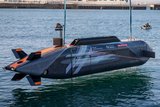
C2 Robotics’ Speartooth large uncrewed underwater vehicle had already undergone live fire tests overseen by the Australian Army last year. (Photo: Gordon Arthur)
Collaboration on AUKUS Pillar 2 extends beyond the core trilateral agreement, presenting global opportunities for companies with advanced technologies.


Autonomous and uncrewed systems are at the heart of Pillar 2 of the tripartite agreement between Australia, the UK and the US – AUKUS – with another round of testing under the Maritime Big Play exercise recently being completed in Australia marking another milestone in the project.
The goal of the Maritime Big Play series of exercises is to allow the three pillar countries, alongside potential external partners including Canada, Japan, South Korea and New Zealand, to test the advanced technologies of multiple companies that aim to tackle threats both above and beneath the water.
In the latest tests, around 30 next-generation
Our news & analysis is now part of Defence Insight®
A Basic-level or higher Defence Insight subscription is now required to view this content.




More from Naval Warfare
-
![France’s naval modernisation drives opportunities for European defence industry]()
France’s naval modernisation drives opportunities for European defence industry
Ahead of Euronaval 2026, major submarine, frigate and aircraft carrier programmes are driving investment, while future corvette replacements and growing interest in uncrewed vessels offer further opportunities for industry into the 2030s and beyond.
-
![Canada assesses security equipment changes for Polar Icebreaker Imnaryuaq]()
Canada assesses security equipment changes for Polar Icebreaker Imnaryuaq
The Canadian Department of National Defence is evaluating communications and reconnaissance changes for CCGS Imnaryuaq’s expanded maritime security role, while retaining its 2032 acceptance target.
-
![All eyes on Royal Navy’s Type 93 market engagement as industry prepares bids]()
All eyes on Royal Navy’s Type 93 market engagement as industry prepares bids
Responses are due by 29 October as the Royal Navy tests the market, with BAE Systems’ Herne and MSubs’ Excalibur setting up a contest where payloads may decide the winner.
-
![US Navy’s MQ-25 Stingray approaches carrier-integration tests]()
US Navy’s MQ-25 Stingray approaches carrier-integration tests
Boeing has outlined its upcoming precision-landing and carrier-airspace trials as MQ-25 manufacturing shifts towards Illinois, with initial Lot 1 deliveries expected in 2029.