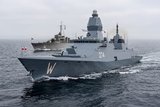
US considers Saudi MMSC ships sale
The US state department has approved a potential foreign military sale to Saudi Arabia for Multi-Mission Surface Combatant (MMSC) ships and associated parts, equipment and logistical support for around $11.25 billion, the Defense Security Cooperation Agency announced on 20 October.
The government of Saudi Arabia has requested the vessels as part of a naval modernisation programme as it seeks to enhance the stability and maritime security in the sea areas around the Arabian Peninsula.
Four MMSC ships have been requested, with supporting equipment including the TRS-4D radar, Mode 4- and Mode 5-capable Identification Friend or Foe systems, and five compact low frequency active passive variable depth sonars.
Weapon systems requested include the MK-41 vertical launch system, 532 tactical RIM-162 evolved sea sparrow missiles; five AN/SWG-l (V) Harpoon ship command launch control systems; eight Harpoon Shipboard Launchers; 48 RGM-84 Harpoon Block II Missiles; five MK-15 Mod 31 SeaRAM Close-In Weapon System; 188 RIM 116C Block II Rolling Airframe Missiles; five MK-75 76mm OTO Melara Gun Systems; and 48 50-calibre machine guns.
Selective Availability Anti-Spoofing Module Global Positioning System/Precise Positioning Service (GPS/PPS) navigation equipment has also been requested.
If the sale goes ahead, Lockheed Martin will be the principal contractor for the MMSC.





More from Naval Warfare
-
![Canada assesses security equipment changes for Polar Icebreaker Imnaryuaq]()
Canada assesses security equipment changes for Polar Icebreaker Imnaryuaq
The Canadian Department of National Defence is evaluating communications and reconnaissance changes for CCGS Imnaryuaq’s expanded maritime security role, while retaining its 2032 acceptance target.
-
![US Navy’s MQ-25 Stingray approaches carrier-integration tests]()
US Navy’s MQ-25 Stingray approaches carrier-integration tests
Boeing has outlined its upcoming precision-landing and carrier-airspace trials as MQ-25 manufacturing shifts towards Illinois, with initial Lot 1 deliveries expected in 2029.
-
![From Poland to the Pacific: can Miecznik become a blueprint for other navies?]()
From Poland to the Pacific: can Miecznik become a blueprint for other navies?
Babcock is taking its Polish industrial partnership approach to Denmark and New Zealand as navies seek sovereign shipbuilding skills alongside ships.
-
![Unsettled waters in the North: can navies still trust their Arctic acoustic maps?]()
Unsettled waters in the North: can navies still trust their Arctic acoustic maps?
The changing Arctic environment is creating new challenges for submarine detection, driving demand for distributed sensors, uncrewed underwater vehicles and real-time acoustic modelling.