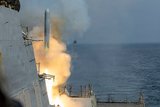
SM-6 interceptor undergoes ‘engage on remote’ tests


The Raytheon Standard Missile-6 (SM-6) interceptor has successfully intercepted targets in ‘engage on remote’ tests conducted as part of the US Navy’s Combat Ship System Qualification Trials.
Conducted from USS Chancellorsville, the trial saw two SM-6 interceptors tested against anti-ship and cruise missile targets. The ship launched the SM-6 interceptors prior to its own radars 'seeing' the incoming threats, using targeting information from another Aegis ship in the area - the USS Sampson.
Raytheon reported that the first SM-6 intercepted a low-altitude, short-range supersonic target, while the second intercepted a low-altitude, medium-range subsonic target.
Mike Campisi, Standard Missile-6 senior program director, said: ‘Advanced warning and cueing from another sensor or ship allows the US Navy to take full advantage of SM-6's over-the-horizon capability. Now the warfighter does not have to wait until the threat is knocking at the door to take it out. Targets are destroyed much sooner and one ship can defend a much larger area.’
SM-6 is designed to provide the US Navy with extended range protection against fixed- and rotary-wing aircraft, unmanned aerial vehicles and cruise missiles. The system uses both active and semi-active guidance modes and advanced fuzing techniques, and incorporates the signal processing and guidance control capabilities from the company’s Advanced Medium-Range Air-to-Air Missile.
More than 130 SM-6 interceptors have been delivered to the US Navy to date.

More from Naval Warfare
-
![Kraken’s Royal Navy USV contract signals next step in crewed-uncrewed integration]()
Kraken’s Royal Navy USV contract signals next step in crewed-uncrewed integration
The UK Royal Navy’s rapid procurement of uncrewed platforms aligns with the force’s strategic shift towards a fleet better equipped to handle modern threats.
-
![HMS Anson’s milestone stay in Australia cut short during AUKUS deployment]()
HMS Anson’s milestone stay in Australia cut short during AUKUS deployment
The Astute-class submarine’s visit to Australia was the first time maintenance activity on a UK Royal Navy nuclear submarine had been carried out in the country.
-
![How Operation Epic Fury could reduce US readiness to face China]()
How Operation Epic Fury could reduce US readiness to face China
The offensive against Iran could impact training and maintenance cycles and accelerate the degradation of the US arsenal on top of depleting Washington’s stockpiles.
-
![UK Royal Navy explores modular counter-drone capabilities for future hybrid fleet]()
UK Royal Navy explores modular counter-drone capabilities for future hybrid fleet
The UK MoD is scoping out systems to counter the growing threat of uncrewed aerial systems, with a focus on low-cost modularity and speed to field.
-
![US Pentagon claims to have severely damaged Iranian capabilities, promises to increase attacks]()
US Pentagon claims to have severely damaged Iranian capabilities, promises to increase attacks
US military authorities claim to have sunk 20 Iranian vessels and destroyed Tehran’s Air Force, with the Pentagon making plans to send additional assets to the region.