SM-3 Block IIA completes second test


The US Navy and the Missile Defense Agency (MDA) have successfully completed the second intercept flight test of Raytheon’s Standard Missile-3 (SM-3) Block IIA.
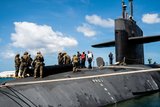
The missile was launched from USS John Finn against a land-launched target resembling an advanced ballistic missile threat.
The next-generation SM-3 Block IIA interceptor is being developed and produced in cooperation with Japanese industry and will be deployable on land as well as at sea. It features larger rocket motors that will allow it to defend broader areas from ballistic missile threats and a larger kinetic warhead. The interceptor’s kinetic warhead has been enhanced, improving search, discrimination, acquisition and tracking functions
Taylor Lawrence, president, Raytheon Missile Systems, said: ‘This second intercept for the SM-3 Block IIA is a success we share with the MDA and the country of Japan, our cooperative development partners. Together, we are building the most advanced solutions for ballistic missile defence.’
Related Equipment in Defence Insight

More from Naval Warfare
-
![US turns to allies to tackle navy shipbuilding backlog]()
US turns to allies to tackle navy shipbuilding backlog
A White House memorandum acknowledges US Navy shipbuilding backlogs and a weakened industrial base, opening a formal path for South Korean and Japanese yards to help rebuild capacity.
-
![US Navy’s $275 billion BBGN plan hinges on shipyard transformation]()
US Navy’s $275 billion BBGN plan hinges on shipyard transformation
The US Navy’s planned nuclear-powered warship carries a US$275 billion price tag, but the greater story lies in the industrial overhaul needed to build it, from AI-enabled design to digital twins and modular construction.
-
![Industry sees opportunity in Australia’s shift to networked undersea warfare]()
Industry sees opportunity in Australia’s shift to networked undersea warfare
Australia’s new defence innovation strategy indicates a shift from platform-centric to network-centric undersea warfare, with Ocius and Anduril Industries pointing to fast-growing opportunities for local industry.
-
![Asia-Pacific emerges as the largest export market for US-made USVs]()
Asia-Pacific emerges as the largest export market for US-made USVs
Asian customers have placed one of the largest known international purchases of US-built uncrewed surface vessels, highlighting accelerating regional demand for autonomous maritime capabilities and distributed naval operations.