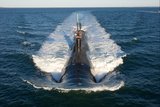
Report: ‘Sudden turn’ by US warship led to collision


A ‘sudden turn’ by the American warship USS John S. McCain led to a collision with a tanker in 2017 off Singapore that left 10 sailors dead, a report by Singapore’s Transport Ministry said on 8 March.
The ministry, releasing the results of its investigation into the incident, said a ‘series of missteps’ by the destroyer’s crew and insufficient action by those of the tanker, the Alnic MC, contributed to the accident.
The vessels smashed into each other in the predawn hours of 21 August 2017 in the busy shipping lanes around the Strait of Malacca. There were no casualties among the tanker’s crew.
The commander of the John S. McCain is facing charges including negligent homicide and dereliction of duty, the US Navy said in January 2018, after its own investigation into the incident found ‘multiple failures’ by the ship’s crew.
Singapore said its 35-page report did not blame any organisation or individual for the fatal crash, but found the warship made an abrupt turn after a transfer of controls caused confusion among the crew.
The report said: ‘The collision... happened because of a sudden turn to port (left) by JSM (John S. McCain), which caused it to head into the path of the (tanker).’
It also noted that several sailors on watch at the John S. McCain during the collision had been assigned from another warship with steering control systems that were ‘significantly different’.
The report said: ‘These differences were not compensated for. Inadequacies in training and familiarisation before the task allocation may have contributed to the actions on John S. McCain.’
The collision took place within three minutes of the warship’s sudden turn, it said, adding however that the actions taken by the tanker’s crew ‘were insufficient to avoid’ the smashup.
The report added: ‘When the bridge team of Alnic MC saw the USS John S. McCain turning, it presumed that the (warship) would be able to safely pass ahead.’
The incident came after another destroyer, the USS Fitzgerald, smashed into a Philippine-flagged cargo ship off Japan in June 2017, leaving seven sailors dead.
In a report on the two separate collisions, US Chief of Naval Operations Admiral John Richardson said both were ‘preventable and the respective investigations found multiple failures by watch standers that contributed to the incidents’.
The US Navy said in November 2017 that the John S. McCain collision ‘resulted primarily from complacency, over-confidence and lack of procedural compliance’.
The US Navy said: ‘In particular, McCain’s commanding officer disregarded recommendations from his executive officer, navigator and senior watch officer to set sea and anchor watch teams in a timely fashion.’


More from Naval Warfare
-
![RTX confirms US Marine Corps and US Navy acquire Hadalus UUV]()
RTX confirms US Marine Corps and US Navy acquire Hadalus UUV
RTX told Shephard that the Hadalus UUV has been procured by the US Marine Corps and the Office of Naval Research for operational experimentation as the company prepares additional demonstrations with the US Navy, NATO and AUKUS partners.
-
![Europe’s naval contractors benefit from growing refit and upgrade demand]()
Europe’s naval contractors benefit from growing refit and upgrade demand
Rheinmetall’s order to modernise the German Navy frigate Bayern points to a wider European shift towards extending warship service life as new-build programmes face delay.
-
![The UK joins the movement towards joint procurement]()
The UK joins the movement towards joint procurement
The UK will spend an estimated US$3.89 billion over the next decade in joint naval programmes, a lot of which will be in cooperation with Norway.
-
![Rheinmetall’s GMF 140: Ambitious frigate or market misfit?]()
Rheinmetall’s GMF 140: Ambitious frigate or market misfit?
Rheinmetall has unveiled its first next-generation frigate design, showing ambitions to compete as a surface combatant prime contractor. While the company is targeting North America, analysts believe the concept may be better positioned for future European programmes.
-
![US Navy $76.6bn award provides stability for submarine production]()
US Navy $76.6bn award provides stability for submarine production
The US Department of War’s US$76.6 billion Columbia-and Virginia-class submarine contract gives industry demand certainty as Washington seeks to rebuild its shipbuilding base.